


What We Learned Deploying AI Inspections Across Real Operations
We learned deploying AI inspections across real operations that AI works best when the workflow, capture standard, and governance are designed for real constraints—not lab conditions. This article explains what consistently broke inspection quality in live yards and terminals, what made adoption stick, where hybrid deployment delivered better outcomes, and what we would change in the next rollout.
Across finished vehicle logistics, inspection performance is shaped less by model sophistication and more by whether the operation can repeatedly produce usable evidence at the right moments of custody. AI can only be as reliable as the images and metadata it receives, and real-world handovers create predictable failure modes unless standards and decision paths are embedded directly into the job.
The real constraints we had to design for in the field
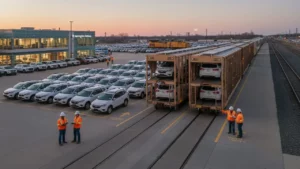
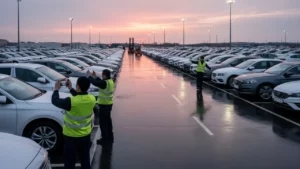
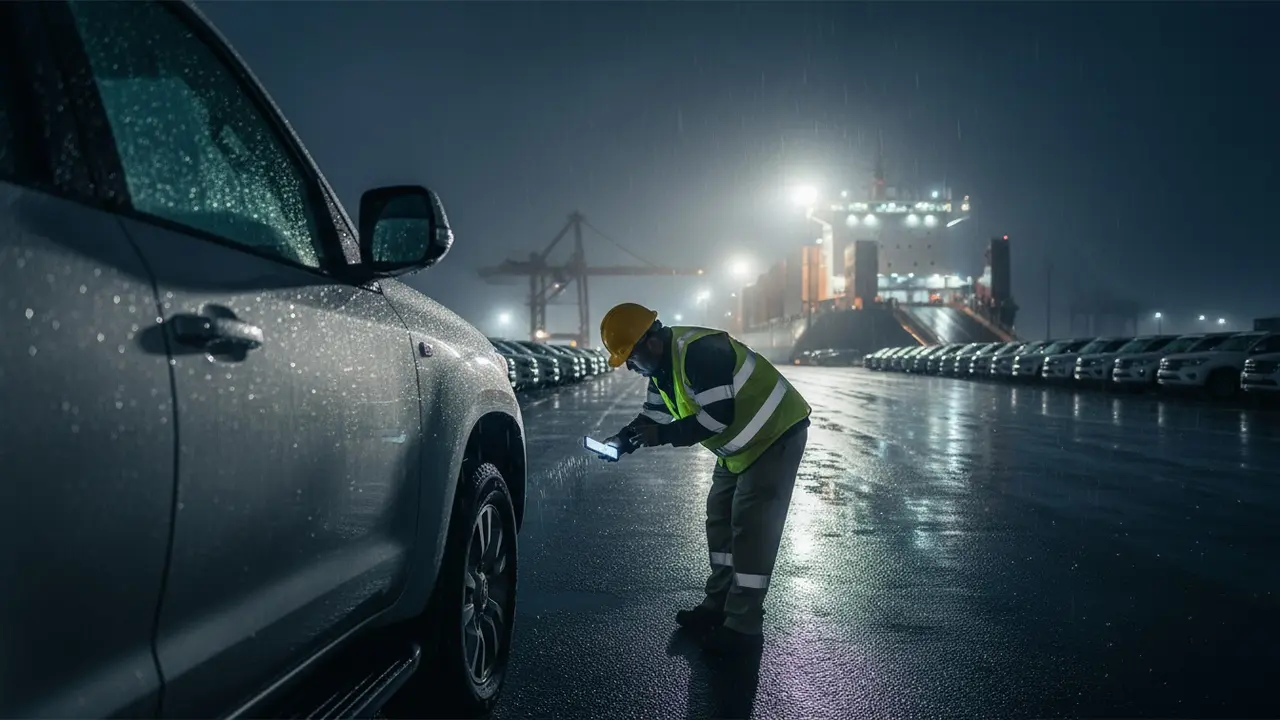
The biggest surprises were not in the AI. They were in the field: lighting shifts across day and night, rain and glare, tight parking that blocks clean angles, two-minute handovers, shift variability, and constant turnover. In that environment, even strong teams struggle to stay consistent, and “just do a thorough inspection” becomes an instruction that collapses under pressure.
These constraints do not only reduce detection quality; they create uneven evidence. When one operator captures a full set of angles and another captures a partial set, you do not just get different outcomes—you get different levels of defensibility when accountability is disputed later. We wrote more about the mechanics of this breakdown in why inspection quality collapses under time pressure.
What changed our approach was treating image capture as operational work with measurable inputs and outputs, not as an informal step “before the real work starts.” That meant designing around the actual constraints: shorter windows at transfer points, limited physical access around the vehicle, and variability by shift and location.
What made adoption stick: standard work, guided capture, and staged rollout
Adoption stuck when we made the correct behavior easy to repeat under time pressure. Standard work mattered, but it could not live only in training slides. It had to be present at the moment of capture, guiding what to photograph, what angles were required, and what constituted acceptable evidence when conditions were poor.
We embedded widely used industry standards directly into capture and review so that damage descriptions and categories stayed consistent across teams and sites. In practice this meant aligning capture and annotation with expectations commonly used across AIAG, ECG, and AAR-style damage reporting, so downstream stakeholders were not forced to reinterpret terminology or reclassify issues after the fact. That governance layer is also why we treat standardization as non-negotiable; as explored in when standards are optional, disputes are guaranteed, optional standards tend to become optional accountability.
Rollout sequencing was equally important. Deployments that worked were staged: one operational node, one process variant, clear acceptance criteria, and only then expansion. When teams try to switch every lane and every shift at once, the first inevitable bad day (weather, backlog, staffing gaps) becomes “proof” that the system does not work. We address this failure pattern in bad rollout design kills adoption.
Turnover made training-heavy strategies fragile. Instead, guided capture and in-workflow checks reduced dependency on tribal knowledge and minimized the gap between “how it should be done” and “how it gets done at 06:10 during a backlog.” This is also why we avoid relying on repeated retraining as the primary control, consistent with the reality described in why training doesn’t scale.
Where hybrid deployment helped most in practice
Hybrid deployment helped where throughput justified deeper automation, but operational variability still demanded human judgment at the edges. In real operations, “hybrid” is not a compromise; it is a deliberate control design. AI provides consistent detection and documentation across large volumes, while human review and exception handling address ambiguous cases, adverse capture conditions, and site-specific rules.
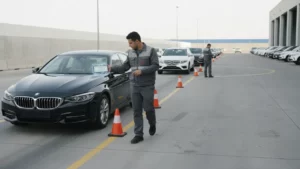
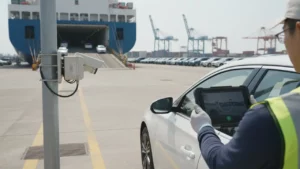
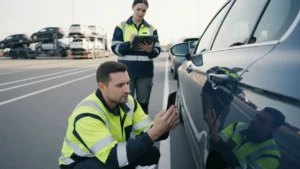
We found hybrid models strongest at custody changes, because that is where accountability is either secured or lost. A mobile-first approach at transfer points ensured evidence was captured at the moment it mattered, not hours later when vehicles had moved and context was gone. The operational logic of this leverage point is covered in the handover moment, and the broader deployment rationale is explored in our view on hybrid inspection.
For teams implementing field capture, we typically recommend starting with mobile because it matches the physical reality of yards, compounds, ports, and rail ramps. For readers who want the practical capture approach, our reference point is mobile AI vehicle inspections.
The real unlock: value came from what happened after detection
The largest step-change in outcomes did not come from “finding more damage.” It came from converting detections into coordinated action that was tracked to closure. In our deployments, that meant issues were not left as photos in a folder or notes in a disconnected system. Instead, detections were turned into assigned follow-ups—repairs, securement fixes, re-inspections, and escalations—so exceptions moved through a managed lifecycle rather than a series of ad-hoc handoffs. This workflow layer is what we describe in from photo to action workflows.
We also learned that claim readiness is a separate capability from detection. Making the record usable later requires structure: consistent capture, standard-aligned categorization, and a complete timeline of custody and evidence. When that structure is missing, teams accrue “evidence debt,” rebuilding the narrative after the fact under time pressure and incomplete context. This is why we treat record preparation as an operational control, aligned with the risks described in evidence debt.
Over time, this reinforced a simple operational truth: inspections do not create value by themselves; closed loops do. The measurable gains appear when exceptions are driven to resolution with accountability, not when damage is merely detected. We expand that logic in closed-loop inspections.
What we’d do differently next time
Next time, we would treat capture conditions and governance as first-class design inputs from day one, not as “rollout tuning.” That means defining minimum acceptable evidence (angles, distance, occlusion thresholds), setting clear rules for when an inspection must be repeated, and designing escalation paths for situations like extreme glare, rain, or impossible access due to parking density.
We would also formalize site readiness earlier: physical space for capture where possible, signage that supports standard work, and shift-by-shift accountability for compliance. Finally, we would spend more time mapping the post-detection operating model—who acts on which exception, within what SLA, and how closure is verified—before scaling volume. For teams planning an adoption program, a useful companion is common failures when adopting AI inspections.
Technology and automation context: why workflow design determines AI performance
Computer vision models are sensitive to variance in lighting, reflections, occlusions, and viewpoint. In controlled environments, these variables are constrained. In finished vehicle logistics, they are the norm. That is why we focus on guided capture and standard-aligned governance: they reduce input variance and increase repeatability, which stabilizes AI outcomes across shifts and sites.
Automation also matters for consistency at scale. When AI assessment and structured evidence capture are integrated into the operational workflow, you reduce reliance on individual discretion and memory. The result is not “automation for its own sake,” but a more predictable inspection process: consistent image sets, consistent categorization aligned with common industry standards, and consistent routing of exceptions into follow-up actions. For readers wanting broader context on digital inspection foundations, see AI digital vehicle inspections.
Conclusion
Deploying AI inspections in real operations taught us that the hard part is not the model; it is making inspections repeatable under real constraints like weather, glare, tight parking, short handover windows, and shift variability. Adoption held when we used standard work and guided capture, embedded industry-aligned standards at the moment of capture, and rolled out in stages that matched operational reality.
Hybrid deployments delivered the best results where custody changes and high throughput justified automation, while humans handled edge cases and local rules. Most importantly, the highest value came after detection—when exceptions were converted into coordinated actions and claim-ready records, tracked to closure. For automotive logistics and finished vehicle stakeholders, that is the difference between adding a tool and implementing a system that can sustain accountability across the network.