


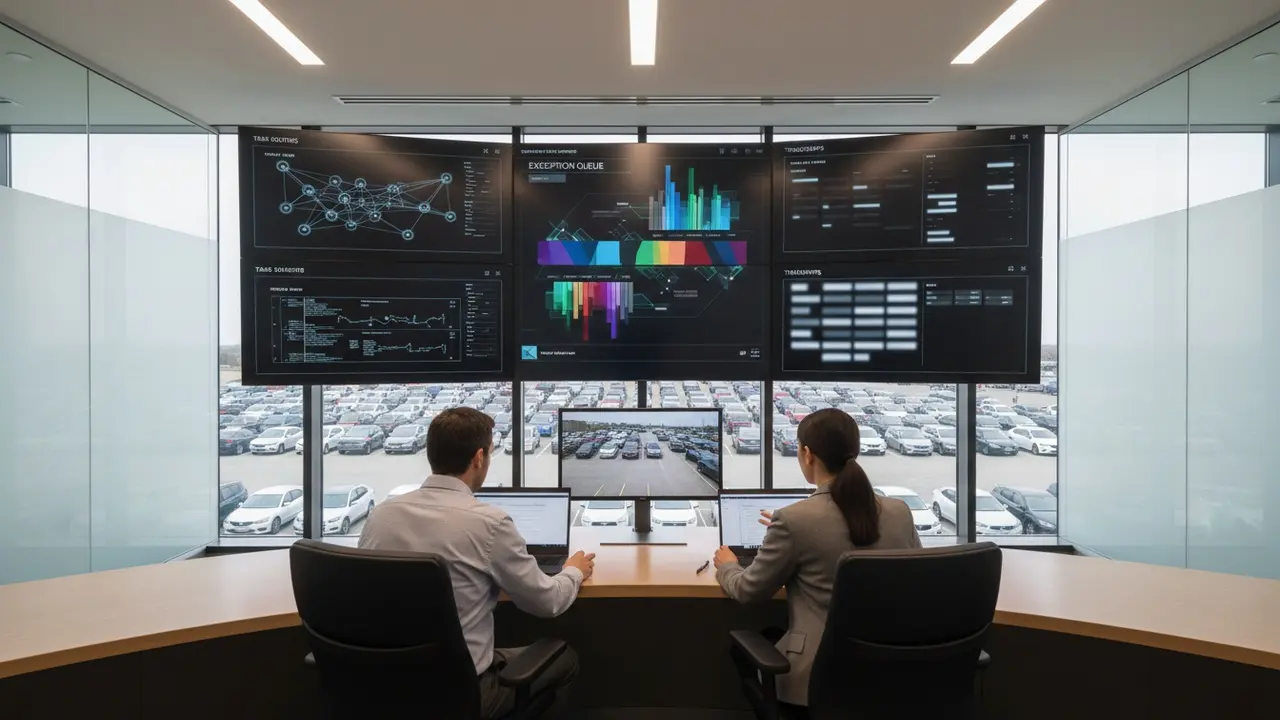

Inspections don’t create value because the value is not in detecting an exception—it is in routing it to the right owner quickly, with proof, and driving it to closure. In finished vehicle logistics, an inspection that stops at “damage found” is often just another record that someone must interpret later, usually under time pressure and across shifting handovers. This article explains why inspection-only approaches turn into documentation theater, what a practical closed loop looks like, what typically slows closure in real operations, and what a minimum viable workflow needs in order to work on a compound, multi-party yard.
Why inspection alone becomes a documentation theater
Inspection alone becomes a documentation theater when the organization treats the inspection output as the end product rather than the trigger for action. In most compounds, rail ramps, ports, and PDI flows, exceptions are operational interruptions that require immediate ownership, not just evidence. If an inspector flags a scratch, missing accessory, broken seal, or transport damage but the finding is not translated into an owned task with a next step, the result is predictable: the vehicle keeps moving, the context changes, and the “exception” becomes a backlog item that is re-litigated later.
This is also where time pressure distorts quality. When volumes spike or departures are fixed, inspection becomes a race against the clock, and consistency drops because the inspection activity is disconnected from resolution. If an inspector knows the finding will not lead to a fast response, the incentive shifts toward “document it and move on,” not “make it actionable now.” Our experience aligns with what we detail in why inspection quality collapses under time pressure: quality deteriorates when the process optimizes throughput without a closure mechanism.
The ‘closed loop’ definition (detect → assign → fix → verify → learn)
A closed loop is a controlled sequence that turns an exception into a resolved outcome with traceable accountability: detect → assign → fix → verify → learn. Detect means the exception is identified and captured with enough context to act. Assign means the exception is routed to a responsible party (role, team, or vendor) with a clear SLA. Fix means the corrective action is performed and logged. Verify means the operation confirms the fix, ideally with comparable proof. Learn means the operation can analyze patterns over time and adjust SOPs, staffing, lanes, or vendor performance.
The crucial distinction is that closed loops treat inspection output as an operational input, not an archive. We built our workflows around this idea because the moment of detection is when context is richest: location, time, vehicle identity, and the people present. If you want a deeper view of how exceptions become owned tasks rather than static photos, see the workflow layer from photo to action.
What slows closure in real ops (missing owner, missing proof, unclear next step)
Closure slows down for three reasons that compound each other in real operations: missing owner, missing proof, and an unclear next step. These are not abstract process problems; they show up at the handover moments between inspector and loader, loader and supervisor, yard and carrier, carrier and OEM, or terminal and repair partner.
- Missing owner means the exception has no explicit assignee who is accountable to move it forward. In practice, that happens when issues are communicated informally (radio, hallway conversations, whiteboards) or when responsibility is ambiguous across teams. Once the vehicle moves to a new lane or a departure clock starts, the cost of finding “who owns this” rises sharply. This is why we emphasize assignment and escalation logic that survives shift changes and handovers, consistent with the handover moment where accountability is won or lost.
- Missing proof means the exception cannot be acted on or defended without rework. Even if everyone agrees that something is wrong, a lack of time-stamped, vehicle-linked evidence forces the organization to reconstruct the story later: which leg, which condition, which checkpoint, and which party had custody. That “evidence debt” is not just a claims problem; it is also an operational closure problem because supervisors and vendors hesitate to act without reliable proof. We explain the operational impact of this in the cost of evidence debt.
- Unclear next step means the process does not specify what happens after the exception is found. Is the vehicle blocked? Is it re-routed to a repair bay? Does it require a supervisor approval? Is there a standard disposition code? Without a defined decision path, the exception sits in limbo, and different roles improvise different actions. The result is variability, delays, and repeat handling.
We saw the real cost of these frictions when we stopped assuming inspections were the product and started observing what happens after an exception is found. In one operation, the “workflow” was essentially manual routing: the inspector walked to an office, wrote on a whiteboard, tried to locate the loader, sometimes called someone, and the loader might check the board later. That simple loop took roughly 6–18 minutes just to notify the right person. During that delay, vehicles continued moving, trains departed, and exceptions disappeared into the noise. The operational lesson was straightforward: detection without immediate routing is not control; it is delayed work creation.
This is also why slow operational closure tends to become slow claims closure. When exceptions are not resolved with a structured trail at the time they happen, downstream stakeholders spend time disputing timelines and custody rather than resolving liability. The knock-on effect is captured in the claims cycle-time trap.
The minimum viable workflow that works
A minimum viable workflow for exception closure is not a complex transformation program. It is a small set of enforceable steps that ensure every exception has an owner, proof, and a disposition path before the vehicle disappears into the next segment.
- Trigger: an exception is detected and immediately generates a task tied to VIN, location, and timestamp.
- Assignment: the task is routed to a named role or team (not a generic inbox), with escalation if it is not acknowledged.
- Proof package: photos, annotations, and contextual metadata are attached so the assignee can act without re-inspection.
- Disposition: the assignee selects the next step (block, re-route, repair, supervisor review, release), so the process is unambiguous.
- Verification: the fix is confirmed and logged, ideally with a post-action capture that closes the loop.
- Learning: exceptions are categorized consistently so the operation can trend root causes and manage performance.
This is the rationale behind why we built Stream: alerts, tasks, ownership, status, and escalation, so that finding an exception automatically triggers the next step instead of creating a note someone might see later. The “learn” step matters because it turns closure into management cadence: recurring exception types can be translated into KPIs for lanes, teams, and vendors, which is how operations move from reactive handling to controlled prevention. For a KPI-oriented view of this management layer, see damage prevention as a KPI.
Technology and automation context
AI and computer vision support closed-loop execution by standardizing what is detected and by making the output immediately actionable at scale. On the detection side, computer vision models can flag visible exterior damage consistently across inspectors, shifts, and sites, reducing the variability that comes from human fatigue and time pressure. On the workflow side, automation matters even more: the system can create structured tasks the moment evidence is captured, attach the proof package, route ownership based on rule sets (lane, carrier, team, contract), and enforce escalation when acknowledgements or fixes do not happen on time.
The operational impact is consistency and speed, not just “better inspection.” The same proof trail that drives closure also prevents rework later. When a claim still occurs, we use that trail in Recover so teams do not rebuild the story from scratch across emails, shared drives, and disconnected systems. If you want the claims-side perspective on why this remains difficult in many organizations, see why claims stay manual.
Conclusion
Inspections create value only when they are connected to a closed loop that drives action: detect, assign, fix, verify, and learn. Without ownership, proof, and a defined next step, inspection becomes documentation theater and exceptions fade into operational noise. Our observation that manual routing can consume 6–18 minutes just to notify the right person highlights why speed and structure matter at the moment an exception is found. For vehicle logistics stakeholders, the practical priority is to treat inspection output as a workflow trigger with enforced accountability and a durable evidence trail, so operations can close issues while vehicles are still in context and downstream claims do not become a second investigation.