

‘Just train people better’ stops working at scale because training improves individual performance, but it does not eliminate the operational constraints and process variability that drive inconsistent inspection outcomes across shifts, sites, and handover points. This article explains what training can realistically fix, where it cannot compensate, and why standard work built around consistent evidence capture is the practical way to scale inspection quality in finished vehicle logistics.
What training fixes vs. what it cannot compensate for
Training helps when the problem is knowledge-based: understanding damage definitions, knowing where to look, following yard safety rules, and using the inspection tool correctly. With good training, teams align faster on terminology, reduce obvious documentation mistakes, and become more consistent in how they describe exceptions.
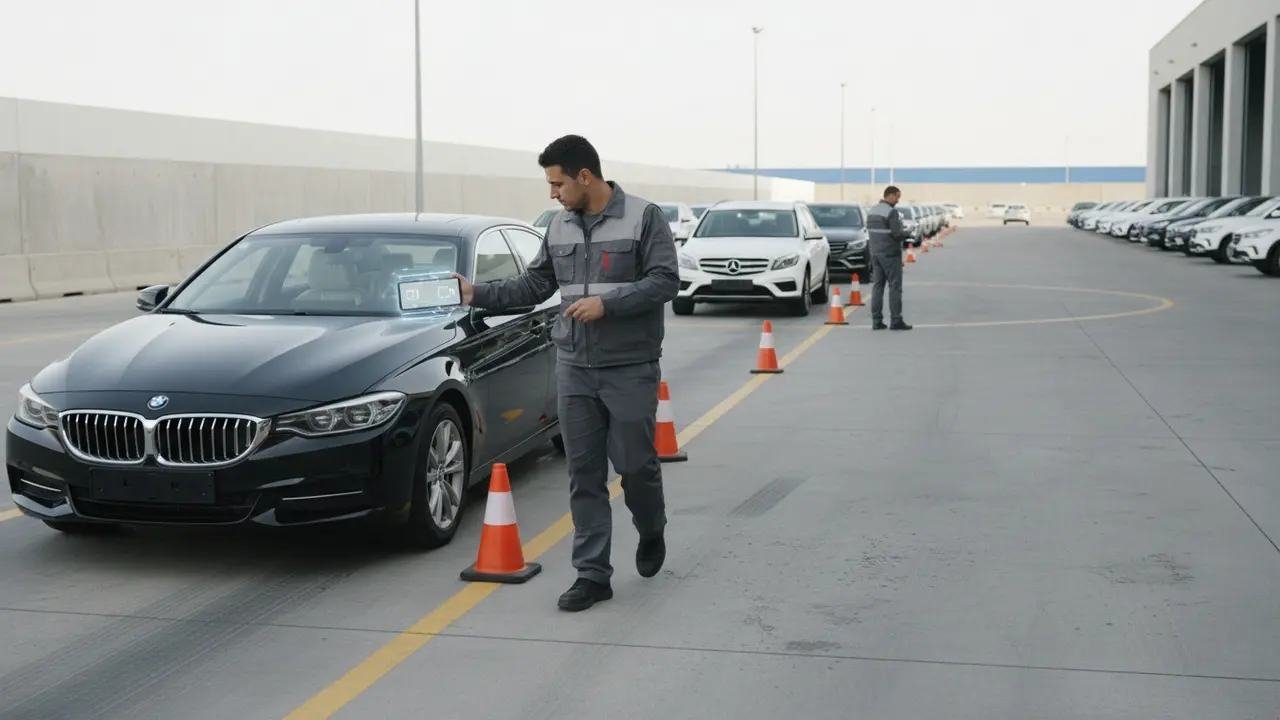
Training does not remove hard constraints that dominate real handover conditions. Under custody-change pressure, inspection personnel frequently operate with roughly 1.5–2 minutes per vehicle, sometimes less depending on the handover point. Vehicles may be parked so tightly that sightlines are blocked, and in many operations personnel are not permitted to move between cars under M22-style safety constraints, even if doing so would reveal damage. Add low light, rain, or glare, and the limiting factor becomes visibility and time, not intent or competence. In that environment, telling people to “be more careful” mostly increases stress and variation rather than improving evidence quality.
Why variability across shifts and sites becomes the default
At scale, inspection outcomes vary because inspection is a human sensing task performed under changing conditions. Two shifts can face different lighting, weather, congestion, and supervision levels. Two sites can have different layouts, lane widths, device availability, and local interpretations of what is “good enough” documentation. When the process relies on individuals to both find exceptions and document them within extreme time limits, results drift naturally from one context to the next.
We see this most clearly at handovers, where the same vehicle can be judged differently depending on who inspected it and how much time was available. The operational reality described in why inspection quality collapses under time pressure is familiar across the sector: the system is optimized for throughput, while inspection quality is expected to remain stable. That mismatch creates inconsistent outcomes that training alone cannot standardize.
Custody changes intensify the requirement for reliable evidence. When accountability shifts between parties, the inspection record must be defensible and repeatable across locations and teams, not dependent on individual diligence in the moment. The problem is less about capability and more about whether the operation has a consistent way to capture proof at the point where liability changes, as described in the handover moment (where accountability is won or lost).
How guided capture becomes standard work under time pressure
Standard work in inspection is not a memo or a training deck. It is a repeatable method that fits inside the real constraints of the lane, the yard, and the clock. The simplest scalable design is to separate “capture” from “finding and documenting exceptions” by making capture the on-site task and letting AI and workflows carry the analysis and documentation forward.
Our operational shift was straightforward: instead of asking personnel to spend scarce minutes trying to spot and document every exception, we asked them to spend that time capturing consistent images with an easy-to-follow guide on their mobile device. This approach reframes the job from subjective searching to objective evidence collection. It also means inspections can remain consistent even when vehicles are tightly parked, personnel cannot step between units, or lighting conditions are poor, because the process is built around capturing what can be captured reliably from allowed positions.
In our deployments, we observed that guided capture produced completely standardized inspections across operators, and the impact on exception detection was material. Based on the captured images, our AI identified 547% more damages compared to what inspectors found during the time-pressured handover process. That result matters because it demonstrates a specific operational point: under custody-change constraints, a consistent capture process can outperform “more training” as the primary lever for quality. This operating model aligns with hybrid inspection, where the field role focuses on fast, structured evidence collection and the exception-finding burden shifts to automation and back-office resolution paths.
For readers who want the mechanism behind the uplift, the core concept is explained in AI car damage detection: computer vision can review standardized image sets consistently, without fatigue, and apply the same detection logic across every shift and site. The point is not to remove human judgment entirely, but to ensure the initial evidence is captured in a repeatable way so downstream decisions are based on comparable inputs.
This is also where process risk is reduced. Inconsistent capture creates “evidence gaps” that surface later as disputes, rework, delayed claims decisions, or ambiguous responsibility. The downstream operational drag is described well in the cost of evidence debt. Standardized capture reduces that debt because every handover produces a predictable evidence package.
Once capture is standardized, standards are no longer optional in practice. They are embedded in the guided flow, which is why the operational outcomes tend to stabilize across sites. This is the practical implication behind when standards are optional, disputes are guaranteed: variability in how evidence is created becomes variability in who is accountable later.
In execution, guided capture is typically implemented as a short, repeatable process:
- Prompt the operator through a fixed capture sequence on mobile, with clear angles and distance guidance.
- Validate completeness at the point of capture so missing views are corrected immediately.
- Upload image sets automatically to a centralized inspection record.
- Run AI analysis consistently across every record to detect, classify, and localize visible damages.
- Route exceptions into the relevant resolution workflow (repair, claim, hold, or escalation).
For a practical view of how mobile-first execution supports standard work in the lane, see mobile vehicle inspections with AI.
Why this approach accelerates onboarding and strengthens audit readiness
High churn and seasonal staffing are persistent realities in yards and terminals. When the inspection method depends heavily on individual experience and “having a good eye,” quality becomes fragile as teams change. Guided capture reduces the training burden because it constrains the task to a small number of repeatable actions. New personnel can contribute predictable outputs faster, and supervisors can focus training on safety, flow discipline, and completeness rather than expecting expert-level defect detection under congestion.
Audit readiness improves for the same reason: evidence becomes structured and comparable. Instead of relying on inconsistent free-text notes or uneven photo habits, each handover produces a consistent record with standardized images and system timestamps. This makes it easier to answer the operational questions that matter in disputes and audits: what was captured, when it was captured, and whether the capture set met the defined standard. Digital inspection records also integrate more cleanly into operational control and exception handling, which is covered in AI digital vehicle inspections.
Once standardized evidence exists, the missing layer is turning it into action reliably. Many operations still struggle not with taking photos, but with consistent routing, prioritization, and closure of exceptions. That workflow layer is addressed in from photo to action workflows.
Technology and automation context: why consistency is the real scaling mechanism
Computer vision delivers value in vehicle logistics when the inputs are consistent enough for automation to be repeatable. That is why guided capture is the enabling layer: it produces standardized image sets that make AI inference stable across sites, operators, and conditions. Without consistent capture, automation quality is limited by missing angles, uneven distances, or incomplete coverage.
In operational terms, automation supports scale through three mechanisms:
- Consistency: the same evidence standard is applied across every handover, shift, and location.
- Throughput alignment: the lane remains optimized for speed because the on-site task is capture, not prolonged searching and documentation.
- Quality control: completeness checks and standardized views reduce the probability of “unknowns” that later become disputes.
This is the practical boundary of training at scale. Training improves people, but automation and standard work stabilize systems.
Conclusion
Training remains necessary in finished vehicle logistics, but it stops being sufficient once operations scale across multiple shifts and sites under tight handover time windows. Real constraints such as limited minutes per vehicle, tight parking, restricted movement between units, and variable weather and lighting create inspection variability that training cannot remove.
Quality scales when inspection is designed as standard work: guided capture that produces consistent evidence, combined with AI-based exception detection and structured workflows for resolution. Our experience with guided mobile capture demonstrated that standardization is achievable under custody-change pressure, and that shifting the field task from “find everything” to “capture consistently” can materially increase what is detected and documented. For logistics operators and OEM stakeholders, the practical takeaway is clear: stabilize the capture process first, then scale decision quality across the network.
