


Why Inspection Quality Collapses Under Time Pressure
Inspection quality collapses under time pressure because misses become a predictable outcome of constrained conditions, variable standards, and human limits—not because people are careless. In finished vehicle logistics, condition checks often happen at high-friction moments where accountability changes hands and documentation becomes the only defensible record. This article explains why defects and exceptions are missed under time pressure, what actually causes variability, and how to stabilize inspection outcomes through standard work, guided capture, and automation.
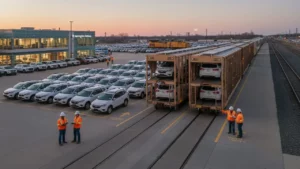
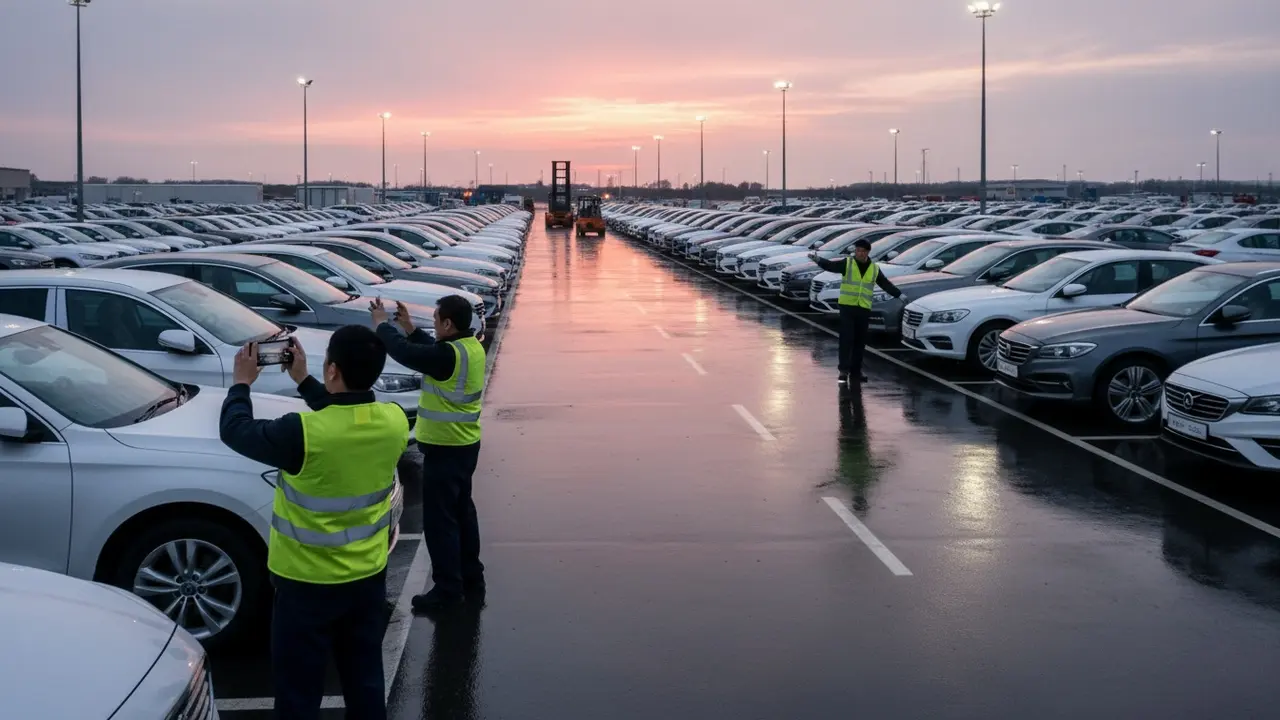
In most yards and terminals, a vehicle damage inspection is not a controlled exercise. It is an operational task executed under throughput pressure, with imperfect lighting, tight parking, and multiple actors working in parallel. When time shrinks but expectations rise, variability becomes the dominant risk factor.
Expectations rise while time shrinks
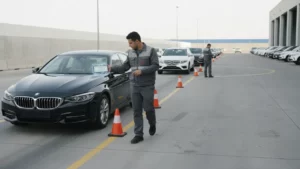
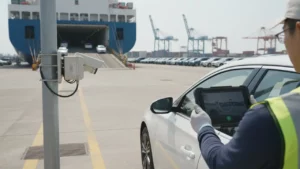
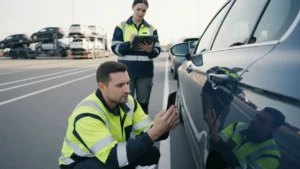
Time pressure in custody-change inspections is structural. In our on-site observations, inspections at responsibility handovers were routinely completed in roughly 1.5–2 minutes per vehicle, sometimes less. In that window, operators are expected to spot exceptions, interpret whether they matter, and document them in a way that will stand up later in claims discussions—often while vehicles are parked tightly with limited sightlines.
This is the handover moment where accountability is won or lost. The operational reality is that several roles may be involved at once (loaders, unloaders, inspectors), and the inspection is competing with other time-critical yard tasks. Under these constraints, the system implicitly rewards speed over completeness, and quality becomes unstable even when effort is high.
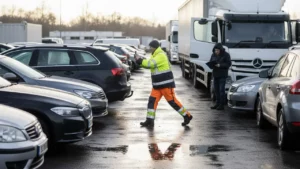
Physical constraints amplify the problem. Vehicles are often parked so close that damage between units is hard to see from normal walk paths. In many operations, movement between rows is restricted by safety rules and yard procedures, which further reduces the number of angles an inspector can realistically access without delaying the flow. Add darkness, rain, glare, and reflections, and the inspection becomes less about diligence and more about what is actually observable in the time available.
For readers who want the broader framing beyond the handover itself, our overview of the vehicle inspection process is a useful reference point for where time pressure typically enters the workflow.
Root causes: fatigue, variability, and unclear standards
The quality collapse usually has multiple causes operating at the same time. Fatigue and attention limits matter, especially in repetitive, high-volume shifts where operators are scanning similar surfaces repeatedly while managing weather, noise, and moving equipment. Under sustained load, people naturally shorten scan paths, rely on heuristics, and deprioritize borderline findings.
Variability is the second root cause. Different operators apply different thresholds for what constitutes an exception, and even the same operator may apply different thresholds across a shift depending on workload and lighting. The result is inconsistent detection and inconsistent documentation, which leads to disputes downstream when parties compare records that were produced under different assumptions.
Unclear or optional standards make this worse. If the expected damage taxonomy, photo requirements, severity definitions, or documentation rules are not enforced uniformly, operators fill in the gaps with personal judgment. When that happens, outcomes vary by person, not by vehicle condition, and disagreements become likely. This is why the logistics reality aligns with the principle that standards are optional only until the first claim escalates.
Training versus standard work and guided capture under real yard constraints
Training helps, but training alone does not reliably stabilize outcomes at scale when turnover is high and experience levels vary. In many yards, inspection work is performed by blue-collar teams with churn, which makes it difficult to maintain a consistent skill baseline over time. That is why the operational question is not only “who is trained,” but “what system prevents drift when conditions and personnel change.” The logic is expanded in our view on why training doesn’t scale as a primary quality control mechanism in high-variance environments.
We learned this directly from field observation. We initially blamed inspectors for missed findings. Then we stood next to them during custody-change inspections and watched the constraints: 1.5–2 minutes per vehicle, tight parking that blocks angles, limited ability to move between cars due to yard rules, and visibility issues from darkness, rain, and glare. In that context, misses are not surprising; they are expected.
So we asked a different question: what if the operator did not have to spend scarce seconds deciding and documenting damage, but could instead spend that same time capturing a consistent set of images? That shift is what we built: guided capture flows that match how yards actually work, including restricted movement, limited lighting, and constant handovers. When we deployed this approach, our AI identified approximately 547% more damage than what was being recorded manually. That uplift was not a signal that people did not care; it showed that the clock consistently wins when the task requires both detection and documentation under severe time constraints.
For teams evaluating implementation paths, AI digital vehicle inspections provides a practical view of how digital capture and automated analysis fit into real inspection workflows. In many operations, the most resilient model is a hybrid inspection approach, where human operators execute standard capture and exception triage while automation stabilizes detection, categorization, and evidence creation.
Once uplift is visible, the next conversation is usually cost and liability. Missed evidence accumulates into evidence debt: situations where disputes cannot be resolved cleanly because condition at handover was never documented consistently enough to establish responsibility.
Checklist to stabilize quality
A checklist is not bureaucracy; it is a mechanism for reducing outcome variance when time is fixed. Under time pressure, quality stabilizes when the process specifies what must be captured, from which angles, and to what minimum documentation standard—so that two different operators produce comparable evidence even in imperfect conditions.
The checklist should be designed around what is feasible in 1.5–2 minutes, not around an ideal inspection bay scenario. In practice, stabilization requires:
- Defining a minimum image set per vehicle that can be completed within the allowed time window.
- Standardizing photo angles and distance guidance so evidence is comparable across operators and shifts.
- Embedding clear exception definitions so the same damage is classified consistently.
- Separating capture from interpretation when possible, so the operator’s limited time is spent collecting usable evidence.
- Including environmental contingencies (low light, rain, glare) with specific capture rules rather than informal workarounds.
- Adding a handover-specific evidence requirement so custody-change records are complete and defensible.
For a detailed starting point, use our vehicle inspection checklist as the baseline and adapt it to yard layout constraints, safety rules, and throughput targets.
Technology and automation context: reducing variance through consistent capture and machine interpretation
Automation supports inspection quality by removing variability in two places where time pressure does the most damage: evidence collection and damage interpretation. Guided capture acts as standard work in motion. It prompts the operator through a defined sequence so that, even when vehicles are tightly parked and the operator cannot walk between rows, the system still collects the best-available set of consistent viewpoints.
Computer vision then applies the same detection logic to every vehicle, regardless of who captured the images or what shift the inspection occurred on. That consistency matters operationally because it makes exception rates, damage localization, and documentation completeness comparable across locations and vendors. It also helps teams move from “did the inspector catch it” to “did the process capture enough evidence,” which is a more controllable quality question.
Where organizations want to operationalize findings, the missing piece is often the workflow layer that turns photos and detections into actions, holds, repairs, or claim packages. This is why we emphasize connecting capture to resolution through from photo to action workflows rather than stopping at image storage.
Conclusion
Inspection misses under time pressure are usually predictable outcomes of constrained visibility, limited time-per-unit, operator fatigue, and inconsistent standards—not negligence. The handover context increases the stakes because condition records become the basis for accountability and claims, and weak evidence creates downstream disputes.
Stabilizing quality requires shifting from person-dependent performance to system-dependent consistency: clear standards, realistic checklists, and guided capture that fits how yards operate. When capture is standardized and interpretation is supported by automation, inspection outcomes become more consistent even when vehicles are tightly parked, lighting is poor, and teams change frequently. That is how automotive logistics stakeholders reduce variability at scale and protect the integrity of custody-change documentation.