


Stop Paying for Damage You Didn’t Cause
You stop paying for damage you didn’t cause by making liability decisions depend on standardized handover evidence rather than on whoever happens to have the weakest proof. In finished vehicle logistics, the commercial reality is that claims rarely follow “truth” on the ground; they follow the strength, comparability, and availability of inspection evidence at each custody change. This article explains why good operators still get blamed, what standardized evidence needs to look like in practice, and how to reduce claim leakage without turning partner networks into blame factories.
Where this becomes urgent is at scale: across yards, rail, compounds, and carriers, unresolved claims accumulate into real margin loss and slower operations. In our own data, around 56% of damage claims never get resolved, which means leakage is not an edge case—it is a structural outcome of weak or non-comparable proof.
Core explanation: liability is a documentation outcome at the handover
In vehicle logistics, liability is decided at handover moments, not at the moment damage occurred. That is why inspection discipline and evidence quality matter more than most operators expect: the party that cannot produce clear, time-stamped, location-specific, VIN-tied proof typically becomes the easiest payer, especially when the vehicle is already close to delivery and pressure to close the case is high. This is also why a “good relationship” between partners does not reliably prevent leakage; relationships help resolve exceptions, but they do not substitute for comparable evidence that holds up when a claim is contested.
The operational consequence is predictable. A claim is raised late, the last custodian is asked to pay, they deny because the damage was pre-existing, and the claim bounces backward across the chain. Everyone spends time defending themselves, and if the evidence trail is incomplete or inconsistent between parties, the OEM often absorbs what never gets resolved. That is not just a claims problem; it is a process design problem.
Liability follows proof, not truth
Liability follows proof, not truth. When inspection outputs differ across partners—different photo angles, inconsistent damage taxonomy, missing timestamps, unclear responsibility markers—the “truth” becomes negotiable. What remains is whose documentation is easiest to use to close the file.
In practice, the last party before the dealership is frequently exposed because they are closest to the point where the damage is discovered and escalated. If earlier handovers did not produce comparable evidence, the last-mile carrier or final yard becomes the default target, even when multiple parties informally “know” the damage happened elsewhere. We repeatedly heard a consistent message across carriers, yard operators, and rail operators: they are willing to pay for the damage they caused, but they are tired of paying for damage that happened earlier in the chain.
This is the same mechanic explored in who actually ends up paying for vehicle damage (and why it’s rarely fair), where liability outcomes are shaped by evidence strength and timing rather than by operational intent.
Once you accept that claims outcomes are documentation outcomes, the strategic priority becomes clear: remove weak-proof positions by ensuring every custody change produces evidence that is consistent, comparable, and claim-ready.
Why good operators get blamed
Good operators get blamed because they often run high-throughput operations where inspection is treated as a necessary control, not as a standardized legal and financial artifact. Under throughput pressure, teams optimize for moving vehicles, not for creating defensible chain-of-custody proof. The result is “evidence gaps” that only become visible when a claim lands.
There are three recurring patterns behind unfair blame allocation:
- Inspection events are not comparable across partners, so later evidence cannot be reconciled with earlier evidence.
- Damage is discovered late, when the vehicle is already at or near retail handover, and urgency to close the case overrides careful attribution.
- Claims handling becomes political because the only available artifacts are partial photos, inconsistent annotations, or free-text descriptions that do not align across companies.
That dynamic contributes directly to unresolved claims. When roughly 56% of claims fail to reach resolution, it is not because people do not care; it is because the chain cannot produce a shared, auditable narrative of condition changes. This is also why the problem compounds over time, as described in the hidden cost of “evidence debt”: weak evidence today becomes recurring financial and operational drag tomorrow.
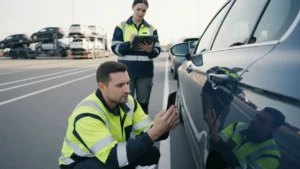
For teams newer to formal inspection governance, it also helps to align on definitions early, including what a vehicle damage inspection is in a finished-vehicle context, because the inspection is not just detection—it is the primary liability instrument at handover.
What changes the game: standardized evidence
Standardized evidence changes the game because it turns every custody change into a comparable, defensible record rather than a one-off set of photos. Standardization is not about forcing every partner into the same internal process; it is about making the output interoperable so that evidence from yard A can be compared with evidence from rail hub B and last-mile carrier C without interpretation battles.
The operational starting point is the handover moment where accountability is won or lost. If the handover inspection produces a consistent evidence package, two things happen: pre-existing damage is documented early enough to prevent misattribution, and new damage is isolated to a narrower custody window, which makes responsibility easier to agree on without escalation.
Standardized handover evidence needs to be specific enough to remove ambiguity. In practice, that means the inspection output should include:
- VIN-linked identity and a clear custody event marker (handover/receipt/release).
- Time and place metadata that reliably pins the condition record to a moment in the chain.
- Consistent image coverage and angles so “no damage” is as defensible as “damage present.”
- Structured damage annotation (location, type, severity) so claims do not depend on free text.
- A responsible party reference tied to the custody event so the dispute is about facts, not about memory.
When those elements are optional, disputes become the default. That mechanism is covered directly in when standards are optional, disputes are guaranteed, and it is why “better cooperation” alone rarely fixes leakage: you cannot negotiate your way out of missing or non-comparable proof.
How to reduce leakage without poisoning partnerships
You reduce leakage without poisoning partnerships by replacing blame-driven conversations with shared evidence and closed-loop exception handling. The goal is not to “win” claims; it is to make attribution fast, repeatable, and minimally disruptive to the vehicle flow.
A practical approach is to treat evidence, workflow, and recovery as one connected loop. Detection alone is not sufficient—value comes from what happens next, including operational tasking, repair decisions, and claim packaging. That is the same principle behind why closed-loop inspections create the real value.
In our work across the chain, we see three connected levers that reduce leakage while keeping partner relationships workable:
- Create comparable evidence at every custody change so responsibility windows are narrow and disagreements are fact-based.
- Coordinate the “messy middle” so exceptions do not stall vehicles while teams argue about next steps.
- Generate claim-ready outputs from the same standardized evidence so resolution is faster and less political.
This is also where cycle time becomes a hidden cost. When claims bounce between parties, the time spent compiling files, re-checking units, and arguing over interpretations becomes operational drag. That dynamic is explored further in the claims cycle-time trap.
Standardized evidence also enables earlier intervention. By tracking vehicles from origin to destination, our AI detected 547% more damage than manual inspections recorded. The point is not to “find more problems” for its own sake; the point is to find exceptions early enough to act while the vehicle is still in logistics, where repairs can often be coordinated in transit and executed at lower cost than at the dealership. We also observed vehicles sitting for 30+ days in yards simply because nobody had a clear, shared next action for an exception. Bridging evidence to action is exactly the gap discussed in from photo to action (the workflow layer FVL has been missing).
Finally, claims remain manual in many networks because evidence is not standardized and outputs are not structured for recovery workflows. When the “proof package” requires human interpretation and negotiation, resolution stays slow even if everyone agrees automation would help. That broader constraint is unpacked in why claims stay manual even when everyone wants automation.
Technology and automation context: why AI makes evidence comparable at scale
AI supports this shift by making inspection evidence consistent across sites, teams, and partners, even when operational conditions vary. Computer vision can standardize what gets captured (coverage and angles), what gets detected (damage localization and classification), and how it is recorded (structured outputs tied to VIN, time, and place). That consistency is what prevents “weak proof” positions from forming in the first place.
In day-to-day logistics operations, the scalability benefit matters as much as accuracy. Human inspection quality fluctuates with workload, lighting, weather, and individual experience. AI-driven capture and interpretation reduce that variability and make “no damage at handover” defensible because the evidence is systematic rather than ad hoc. The operational impact is straightforward: earlier detection narrows the liability window, standardized outputs reduce dispute interpretation time, and structured evidence accelerates recovery decisions. For readers evaluating the inspection layer itself, AI-powered digital inspections (accuracy and evidence quality) provides a deeper view of how digital inspections translate into stronger documentation.
Conclusion
You stop paying for damage you didn’t cause by removing weak-proof positions from the chain and making every custody change produce standardized, comparable evidence. In practice, that means accepting that liability outcomes are shaped by documentation, recognizing why even strong operators get blamed when inspection outputs are inconsistent, and implementing a shared evidence standard that partners can align around without constant negotiation.
Our observations across carriers, yards, and rail operators point to the same root issue: teams are willing to pay for what they did, but they cannot keep absorbing what they cannot disprove. With roughly 56% of claims failing to resolve in our data, leakage is happening at scale. Standardized evidence, closed-loop exception handling, and claim-ready outputs shift the conversation from blame to facts—protecting margin, reducing cycle time, and keeping vehicles moving for OEMs, LSPs, and finished vehicle logistics stakeholders.