


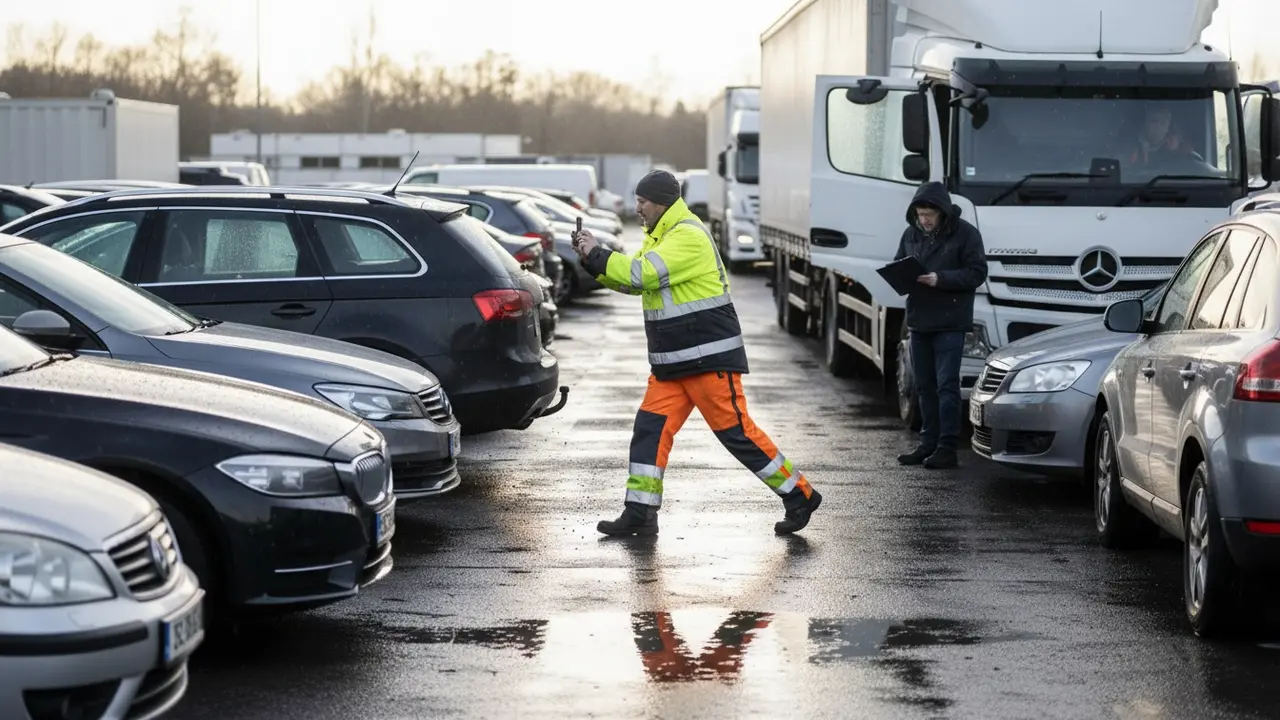

Standards fail in the field (even when everyone agrees) because the gap is rarely knowledge—it is usability under time pressure at the handover moment. Most vehicle logistics teams understand why standardized damage coding and consistent evidence matter, but real operations force decisions in minutes, often under constraints that make “perfect compliance” hard to execute.
This article explains why M-22 is widely accepted yet inconsistently applied, what the operational failure modes look like, and what actually enables compliance without changing the standard: workflows, required fields, mapping at capture, and a claim-ready evidence package that remains comparable across parties.
For a short refresher on what an inspection is meant to produce at custody change, see our overview of vehicle damage inspection.
Start with agreement: M-22 is the standard, and it’s there for a reason
M-22 exists because finished vehicle logistics needs a shared “damage language” that can survive handovers between OEMs, LSPs, ports, compounds, carriers, dealers, and claims teams. When damage is described and coded consistently, it becomes comparable: the same dent on the same panel should resolve into the same code and the same type of supporting evidence, regardless of where it was recorded.
In practice, teams align around M-22 because it reduces ambiguity in damage descriptions, supports operational reporting, and provides the structure claims teams need to evaluate responsibility and cost. Agreement is not the problem. The execution environment is.
Why compliance breaks in real operations
Compliance breaks in real operations because custody-change inspections happen in minutes, not in ideal conditions. At handover, the priority is flow: keep the load line moving, clear the yard, meet driver schedules, and prevent congestion. That moment is also where accountability is set, which is why we describe it as the handover moment (where accountability is won or lost).
The operational failure modes are predictable in finished vehicle logistics:
- Time pressure at reception, load line, or delivery pushes inspectors toward abbreviated capture and shorthand descriptions.
- Shift variability changes how strictly required fields are enforced and how “edge cases” are interpreted.
- Manual recoding after the fact introduces translation loss: what was seen on the yard becomes reinterpreted later at a desk.
- Multiple parties use different internal taxonomies and local terminology, even when everyone claims to follow the same standard.
We have consistently seen the same pattern in our own deployments: the biggest blocker to M-22 compliance is not willingness. It is that inspections are performed under real constraints—tight yards, poor lighting, weather exposure, and high churn—during custody change. When coding is postponed and done manually later, inconsistency and rework become the default outcome. This dynamic is also unpacked in why inspection quality collapses under time pressure.
The hidden cost of non-compliance: disputes stall when evidence is not comparable
Non-compliance rarely shows up as a single obvious failure. It accumulates as what we call evidence debt: missing required fields, photos that do not support a classification, codes applied inconsistently, and reports that cannot be compared across parties or time. That debt is expensive because disputes do not stall on opinions—they stall on comparability.
When damage coding and evidence packages diverge, disputes slow down for structural reasons:
- Condition-at-delivery proof becomes hard to establish when the “before” and “after” inspections are not captured in the same schema.
- Exception types cannot be routed reliably when different partners describe the same situation differently.
- Claims teams spend time translating, rekeying, and requesting clarification rather than validating responsibility.
This is why standards cannot be treated as optional operational guidance. When standards are optional, the dispute process becomes predictable back-and-forth, as described in when standards are optional, disputes are guaranteed. The downstream drag is also captured in the cost of evidence debt: the longer evidence remains incomplete or incomparable, the more manual work is required to make it usable for claims and partner alignment.
What actually enables compliance without changing the standard
What enables compliance is not a new standard or more training slides. It is making the standard executable at the moment the information is created. In finished vehicle logistics, that moment is capture during inspection at custody change, not later re-entry in an office workflow.
In our platform, we designed compliance to be a default outcome by building AIAG / ECG M-22 coding at capture. The operational principle is simple: detecting damage is not sufficient if it is not coded correctly and packaged with the right metadata and images. When the photo is taken, the system maps it to the correct M-22 structure immediately, so outputs can move downstream without manual recoding.
In practical terms, this requires a workflow layer that makes correct capture the easiest path, which we describe in from photo to action (the workflow layer). The enabling mechanisms are:
- Capture workflows with required fields that match the operational moment (reception, load line, delivery, campaigns), so inspectors cannot accidentally skip what later becomes “missing evidence.”
- Automatic mapping to M-22 at capture, removing the “translate later” step that introduces inconsistency.
- Consistent photo and evidence packages, so the same exception type yields the same minimum proof across shifts and sites.
- An audit trail that ties the inspection to VIN, time, place, and responsible party, so responsibility discussions are anchored to the same record.
This also addresses a common blocker to automation in claims: even when organizations want to digitize, outputs are often not structured enough to flow into downstream processes. We have seen that when coding is performed at capture, the inspection output becomes claim-ready rather than “report-like.” That dynamic is explored further in why claims stay manual.
What “good” looks like when compliance becomes the default
Good looks like compliance that is routine, not heroic. The standard remains the same, but the operating model changes: capture produces structured, comparable records that can be routed, reconciled, and closed without repeated translation.
In our own product architecture, this is why we treat inspections as part of a unified loop rather than a standalone report. When we map M-22 at capture in Inspect, it unlocks two downstream behaviors:
- Stream can route standardized exception types into tasks and alerts across multiple parties without redefining categories site-by-site.
- Recover can synchronize claim-ready outputs into claims systems and forms without manual recoding or rekeying.
The operational outcomes are measurable in the workflow, not just in dashboards: fewer escalations caused by ambiguity, faster closure because evidence and codes are comparable, and cleaner integration into OEM and claims processes because the output is structured from the start. This is also where cycle time often gets trapped when evidence is incomplete, as described in the claims cycle-time trap.
When teams adopt this closed-loop approach, the inspection record becomes an operational artifact that drives actions and resolution, not a document that creates follow-up work. The broader operating model is covered in closed-loop inspections.
Technology and automation context: why “coding at capture” changes scalability
In finished vehicle logistics, automation only helps if it increases consistency under pressure. Computer vision can detect damage, but operational value comes from standardization: the same input conditions must produce the same coded output and evidence package at scale, across yards, shifts, and partners.
By applying computer vision to generate standardized outputs at the moment photos are taken, we reduce the variability introduced by deferred manual coding. That has direct operational impact:
- Accuracy becomes auditable because photos, codes, and metadata are tied to a single event record.
- Scalability improves because new sites and partners inherit the same required fields and evidence structure.
- Interoperability improves because outputs align to AIAG / ECG M-22 expectations, which downstream stakeholders already recognize.
In other words, the technology is not replacing the standard. It is making the standard usable in the place it typically fails: the high-throughput, imperfect conditions of custody change.
Conclusion
Standards fail in the field when the operational environment makes them hard to execute. With M-22, the breakdown is rarely disagreement—it is the reality of inspections performed in minutes at handover, across shifts, under poor lighting, weather constraints, and high churn, with manual recoding later creating inconsistency.
Compliance becomes reliable without changing the standard when teams design for capture: required fields, automatic M-22 mapping at the moment photos are taken, consistent evidence packages, and a clear audit trail. When those elements are in place, comparability improves, disputes close faster, and integrations into OEM and claims processes become straightforward because the output is structured and claim-ready from the start.
