



Who Pays for Damages (and Why It’s Rarely Fair)
Who pays for damages is rarely decided by what truly happened; it is usually decided by what each party can prove at the moment custody changes. In finished vehicle logistics, condition reporting sits at the boundary between operations, contracts, and claims. When evidence is incomplete or inconsistent, responsibility shifts toward the party that cannot defend condition at handover, not necessarily the party that caused the damage. This article explains why custody change becomes the “truth moment,” why disputes often drag, and what practical standards and tooling reduce friction and accelerate closure.
At a high level, the industry intent is straightforward: identify when damage occurred, assign liability to the responsible party, and settle the claim. In practice, the process behaves differently. Most liability discussions collapse into a documentation discussion: which inspection exists, how it was taken, whether the photos match, whether the damage coding is comparable, and whether timestamps and locations align to a custody timeline.
How liability works in the real world: custody changes create ‘truth moments’
Liability works in the real world by concentrating accountability into the few moments where vehicles change hands and someone signs or accepts a condition record. Those custody changes are operationally convenient checkpoints, but they also become legal and financial pivots because they are the only moments where evidence is expected to be refreshed and mutually recognized.
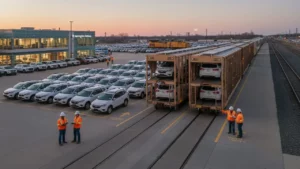
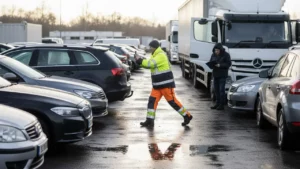
This is why we describe custody changes as “truth moments.” If a vehicle is photographed and coded consistently at gate-in, railhead discharge, compound release, or dealer receipt, the damage timeline becomes defensible. If it is not, the timeline becomes debatable, and debates tend to default to the last clearly documented checkpoint. That dynamic is explained in the handover moment where accountability is won or lost.
In our own data, we expected liability to be a rulebook problem. It is often a proof problem. In practice, “who pays” is decided by who can prove vehicle condition at custody change. This is also why the last custodian before the dealership is blamed so often: not because they caused the damage, but because they are the easiest party to point at when the record is weak. When proof is weak, claims bounce between stakeholders until everyone is fatigued by the administrative load, and the claim gets absorbed. In our dataset, around 56% of claims never reach a clear resolution and the OEM absorbs the cost. That is also why we emphasize unified workflows that produce comparable evidence and coordinated action rather than denial loops; many disputes are avoidable if the record is system-ready before the escalation begins. If this dynamic sounds familiar, the operational implication is simple: weak handover evidence quietly shifts cost to whoever is least able to demonstrate condition, not to whoever actually caused the exception. It is the reason many teams search for ways to stop paying for damage you didn’t cause.
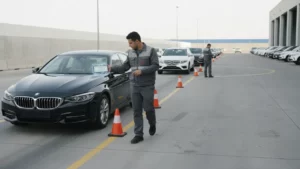
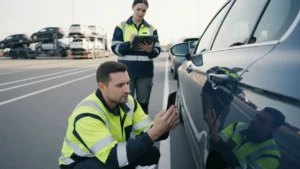
Because the handover record plays such an outsized role, the inspection itself matters more than many organizations expect. A vehicle damage inspection is not only an operational quality check; in claims reality it is the core liability artifact.
Transport vs non-transport damage (why it matters)
Transport versus non-transport damage matters because it changes which contractual lane the claim runs through, which evidence is considered relevant, and which stakeholder is incentivized to contest the outcome. A scratch identified at dealer receipt could originate in linehaul, in a compound move, during workshop handling, or through post-delivery activity. Each scenario implies different responsible parties, different documentation expectations, and different dispute patterns.
Operationally, the distinction affects how stakeholders interpret “when” and “where.” Transport damage is typically evaluated against custody and movement milestones: load, discharge, gate-in, gate-out, and delivery. Non-transport damage is more likely to be argued in relation to storage practices, yard operations, accessory fitting, valeting, or dealer handling. When the evidence package does not clearly anchor damage to a time window and location, debates become semantic: parties argue about categories rather than the observable condition delta between checkpoints.
Why disputes drag (inconsistent evidence + inconsistent language)
Disputes drag because participants are often trying to reconcile evidence that was never designed to be compared. One party submits a handful of photos with no consistent angles; another submits a checklist with generic location text; a third uses different severity thresholds or damage codes. Even when everyone is acting in good faith, the claim file becomes a collage rather than a timeline.
The second drag factor is inconsistent language. Damage location nomenclature, part naming, severity scales, and even definitions of “new” versus “prior” damage vary across organizations and geographies. That inconsistency inflates rework: someone must interpret, re-label, request clarifications, and re-open the file. Over time, this creates an evidence backlog that becomes expensive to unwind, a pattern we discuss in the cost of evidence debt. Manual handling then compounds the delay, because each clarification round-trip typically lives in email, spreadsheets, and portals that are not synchronized. If teams want to understand why this persists even with strong intent to modernize, the operational constraints are laid out in why claims stay manual.
Our dataset observation that roughly 56% of claims never get resolved is a symptom of these two issues working together. When evidence cannot be compared and language cannot be aligned, closure becomes a negotiation exercise rather than a decision exercise. The default outcome is not “fair,” it is “absorbed,” usually by the party with the least appetite to keep the dispute alive.
What reduces friction: one condition-report standard, timestamped evidence, comparable coding
Friction reduces when condition evidence is created to be comparable across custody points, not merely captured for local use. That means stakeholders agree on a shared condition-report structure and produce artifacts that can be read consistently by humans and systems. The logic is simple: if inputs are standardized, decisions become faster and escalations become rarer. The broader industry lesson is captured by the premise that when standards are optional, disputes are guaranteed.
A practical condition-report standard should be built around three elements:
- A single, repeatable inspection flow that produces the same viewpoints and coverage at each custody change.
- Timestamped, location-linked evidence so the claim file ties condition to a specific handover window rather than an approximate period.
- Comparable coding for damage type, location, and severity so differences between two inspections can be evaluated as a delta, not interpreted as subjective descriptions.
To make that standard operational, the report format must also be system-ready. A standardized vehicle inspection report helps because it defines what a downstream claims handler can reliably expect: consistent panels, consistent terminology, and consistent media attachments. In our workflows, this is where a unified platform matters. Inspect produces comparable evidence at the moment it counts. Stream creates coordinated action so exceptions move forward instead of cycling through denial and re-submission. Recover accelerates claim handling because the record is already structured for decisioning, not rebuilt after the fact.
What ‘fair’ looks like: faster closure + fewer escalations
What “fair” looks like is faster closure with fewer escalations, because fairness in claims is inseparable from timeliness and repeatability. When a claim takes months, the operational cost spreads across multiple teams: repeated touchpoints, follow-up inspections, storage of disputed units, and internal write-offs. Speed matters not just for cash recovery, but for reducing the managerial burden and preventing disputes from becoming permanent exceptions. The delay dynamics and their cost profile are explored in the claims cycle-time trap.
In practice, fair outcomes emerge when each party can see the same custody timeline, evaluate the same comparable condition deltas, and rely on the same definitions of damage attributes. That does not eliminate disagreement, but it makes disagreements resolvable. It also reduces the tendency to default-blame the most recent custodian simply because their paperwork is the only complete artifact in the chain. For stakeholders looking to operationalize this shift, aligning on inspection solutions that improve transparency is less about adding another tool and more about ensuring the evidence and actions are connected across inspection, exception management, and claims.
Technology and automation context: how AI makes condition evidence comparable at scale
AI and computer vision support this topic by making condition evidence consistent, comparable, and scalable across many handover points. The operational value is not “automation for its own sake,” but the reduction of ambiguity that feeds disputes.
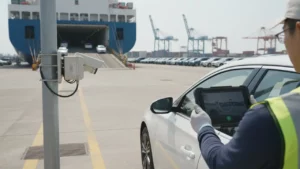
In a unified workflow, AI-enabled capture helps standardize how images are taken and how damage is identified and described. That consistency enables two inspections from different sites or vendors to be compared without translation work. It also helps create structured outputs that are ready for claims handling rather than re-keying. This is the practical advantage of digital inspections with timestamped evidence: the evidence package becomes a timeline artifact, not a collection of disconnected files. When the inspection output is consistent, the custody-change “truth moment” becomes defensible, and the liability conversation shifts from negotiation to verification.
Conclusion
Who pays for vehicle damage is rarely decided by who is right in principle; it is decided by who can prove condition at custody change. Custody points become “truth moments,” and when evidence and language are inconsistent, disputes drag, bounce between stakeholders, and often end in absorption rather than resolution. Our observation that around 56% of claims in our dataset never resolve reflects how frequently proof gaps, not contract logic, determine outcomes.
For finished vehicle logistics stakeholders, the practical path to fairer outcomes is clear: standardize the condition report, capture timestamped and location-linked evidence at every handover, and use comparable coding so differences can be evaluated as deltas. When inspection, exception handling, and recovery are connected in one workflow, closure becomes faster and escalations become less common, which is what “fair” looks like in day-to-day operations.