


What OEMs Actually Want From Logistics Providers (But Rarely Say Out Loud)
OEMs want logistics providers to deliver provable outcomes—especially around damage, handovers, and claims—not just well-written service descriptions. Finished vehicle logistics procurement is moving away from narrative promises like “quality” and “tight process” toward evidence that performance is measured, repeatable, and auditable across custody changes. This article explains what that shift looks like in practice, which KPIs signal credibility, and why packaging quality and claims as a managed service is becoming a real differentiator in tenders.
Why tenders are shifting from service descriptions to measurable outcomes
When tender responses rely on the same language—damage prevention, process discipline, continuous improvement—the buyer’s risk does not decrease. The operational risk for an OEM sits in the gaps between parties: when a vehicle changes custody, when a subcontractor is involved, or when exceptions appear and no one can prove what happened. That is why measurable outcomes are increasingly becoming procurement criteria: they reduce ambiguity at handover, narrow dispute windows, and convert “we follow a process” into “we can demonstrate control.”
In our experience, the difference is rarely intent. It is instrumentation. If inspection evidence is inconsistent, timestamping is weak, images are incomplete, or damage codes are interpreted differently across sites, then the system becomes fragile under volume. That fragility shows up later as preventable claims friction, longer cycle times, and avoidable escalation—effects that procurement teams now recognise as structural, not incidental. This is also where the cost of evidence debt becomes tangible: missing or non-standardised proof today becomes disputes, delays, and write-offs tomorrow.
What we observed when we instrumented real operations
In tenders, everyone sounds the same because everyone describes intentions. In the yard, the buyer’s real problem is simpler: can you prove what happened at each custody change, and can you resolve exceptions without operational chaos?
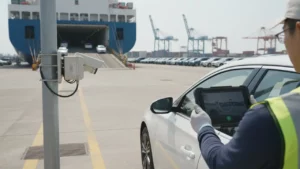
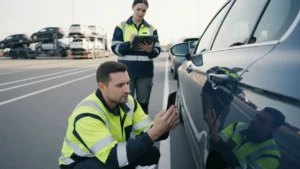
When we instrumented real operations with AI-based inspection, we consistently saw meaningful damage presence: roughly 19.6% of inspections showed damage found by AI. We also saw a substantial gap versus what was being captured manually—AI surfaced around 500–547% more damage instances than manual recording. That does not indicate poor operator performance; it indicates a system that is sensitive to human variability, time pressure, inconsistent capture angles, and documentation habits. If the recorded baseline is unstable, then any tender promise built on that baseline is hard to defend.
This is why proof becomes differentiation. Evidence capture (Inspect) is what establishes defensible handover documentation, workflow coordination (Stream) is what keeps exceptions moving across subcontractors instead of stalling, and claims closure (Recover) is what converts evidence into outcomes that procurement can measure. For deeper operational detail on this pattern, see what we learned deploying AI inspections in real operations, and for the underlying accountability dynamic, see the handover moment where accountability is won or lost.
Shift to measurable performance
The procurement lens is increasingly performance-based: OEMs want to know not only what you do, but what the outcome will be and how it will be verified. That pushes providers to operationalise quality into measurable controls that survive scale, subcontracting, and peak volumes.
Practically, this means tenders increasingly reward providers who can show: consistent inspection coverage, standardised damage classification, clear ownership at handover points, and closed-loop execution after a defect is found. In other words, performance is evaluated as a system across the transport chain, not as isolated activities. This is also where AI becomes relevant as an enabler of consistency rather than “innovation theatre,” which aligns with our view in AI as the new differentiator in FVL tenders.
Five KPIs that signal credibility in an OEM tender
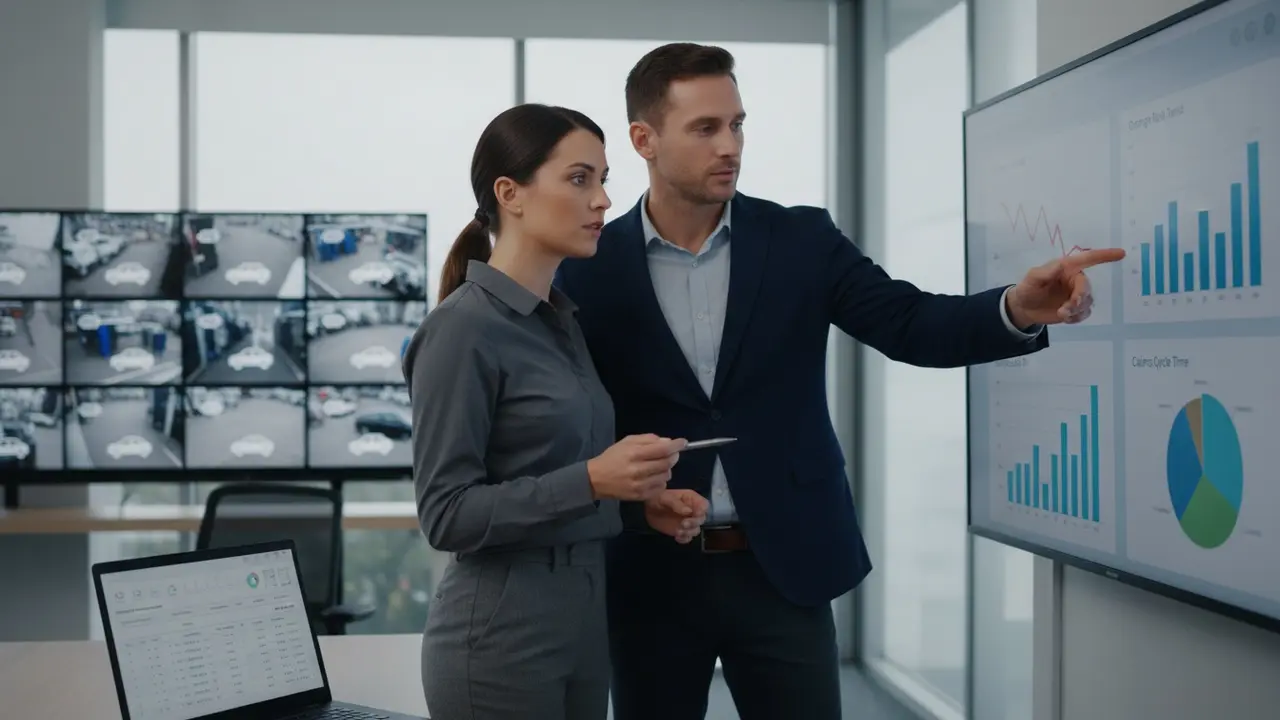
OEMs rarely ask for “AI.” They ask for credible control. The easiest way to demonstrate that control is to commit to KPIs that are hard to manipulate and easy to audit across sites and partners. The following KPIs tend to separate providers who describe quality from providers who manage it.
- Damage detection rate at each custody-change point, defined by inspection coverage rules and consistent capture requirements.
- Repeat damage rate by lane, site, carrier, and subcontractor, showing whether corrective actions actually reduce recurrence rather than just reclassify issues.
- Exception resolution lead time from detection to action assignment to completion, demonstrating that exceptions do not linger unowned in email threads.
- Claims cycle time from filing to settlement or closure, with transparency on what evidence was used and when responsibilities were accepted.
- Evidence completeness and auditability, measured as the proportion of handovers with timestamped, location-linked, standard-angle image sets and consistent damage coding.
These KPIs work because they align to buyer pain: they reduce ambiguity at handover, quantify whether prevention is real, and constrain downstream claims uncertainty. This is also why damage prevention isn’t a project—it’s a KPI is more than a slogan in tenders: if you cannot measure prevention outcomes, you cannot credibly price risk or defend performance.
Packaging quality and claims as a managed service
Many logistics providers still treat quality and claims as adjacent support functions: inspections generate photos, claims teams chase documents, operations teams handle exceptions when time permits. OEMs increasingly prefer the opposite: a managed service that links evidence capture, exception handling, and claims closure into one accountable operating model.
A managed service approach is defined by explicit interfaces and ownership, not by additional reports. It standardises what gets inspected, how evidence is stored, how exceptions are routed, and what “closed” means. It also makes subcontractor performance visible without relying on informal escalation. Two practical building blocks are especially important:
- Closed-loop exception workflows that connect detection to corrective action and verification, rather than treating inspection as a standalone step. For the operational logic behind this, see closed-loop inspections and from photo to action workflows.
- Claims operations designed around cycle time and evidence quality, not only claim count. The aim is to reduce rework, disputes, and “missing proof” loops that keep claims open. This is where the claims cycle-time trap becomes relevant: cycle time becomes a performance signature that OEMs can compare across bidders.
Importantly, this packaging changes tender posture. Instead of describing processes, you describe controllable outcomes: how fast exceptions are resolved, how disputes are prevented through standardised evidence, and how quickly claims reach closure with clear responsibility.
Why this is differentiating now
This tender shift is differentiating because it exposes a common weakness: many providers operate with fragmented evidence and informal exception handling. Under that model, a provider can sound strong in procurement language while still being weak at custody-change proof and cross-party resolution.
When we talk about AI as a differentiator, we are not referring to novelty. We mean reliability at scale: consistent inspection outputs, standardised documentation at handover, and operational workflows that turn findings into actions across multiple actors. For readers who want a baseline definition of the inspection function itself, see what a vehicle damage inspection is. For those evaluating implementation, AI digital vehicle inspections provides a practical overview of how digital inspection systems are deployed.
Technology and automation context: how AI supports measurable outcomes
Measurable outcomes require measurement that is consistent under operational constraints. Computer vision supports this by applying the same detection and classification logic across inspectors, shifts, weather conditions, and sites, while producing standardised evidence sets that can be audited later. The operational value is not “automation” in the abstract; it is the reduction of variability in what gets captured and how it gets interpreted.
In practice, AI-enabled inspection and exception handling systems strengthen tender credibility when they produce structured outputs that can be tied directly to KPIs:
- Time- and location-linked inspection records that anchor custody-change accountability.
- Standardised damage annotations that reduce interpretation disputes between parties.
- Workflow states for exceptions and claims that make lead times measurable and comparable across partners.
This is also why our observed gap between AI-detected findings and manual recordings matters in tender terms. If the manual system under-captures damage or captures it inconsistently, then any downstream KPI—damage rate, repeat damage, claims liability—rests on an unstable foundation. Automation is valuable because it makes the foundation measurable and repeatable, not because it replaces people.
Conclusion
OEMs increasingly want logistics providers to prove performance at the points where risk concentrates: custody changes, exceptions, and claims closure. Tenders are therefore shifting toward measurable outcomes backed by auditable evidence, rather than descriptions of quality intentions.
Providers that commit to credible KPIs—such as damage detection rate, repeat damage rate, exception resolution lead time, claims cycle time, and evidence completeness—signal operational control in a way that procurement can compare across bidders. Packaging quality and claims as a managed service, supported by consistent AI-based evidence and closed-loop workflows, turns tender language into an operating system that reduces disputes and makes accountability explicit for OEMs, carriers, terminals, and compound operators.