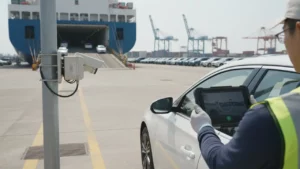




The Scratch That Bankrupted Trust
The Scratch That Bankrupted Trust: why does a small defect trigger big losses in finished vehicle logistics?
The biggest cost is not the damage itself; it is the dispute cycle that starts when handover evidence is inconsistent, incomplete, or not comparable across parties. In finished vehicle logistics (FVL), a single minor scratch can create weeks of back-and-forth because each custodian documents condition differently, at different moments, and with different standards. This article explains how the same defect turns into multiple “truths,” why liability discussions spiral into email loops, and what breaks the loop: consistent evidence, reliable timestamps, and one shared standard that produces claim-ready records at the moment custody changes.
Why the biggest cost is the dispute cycle, not the dent
In FVL, damage cost is rarely limited to the repair line item. The larger exposure sits in the time and friction required to determine when the damage occurred, who had custody at that time, and whether the defect meets a claim threshold under contract and carrier rules. When evidence is weak, every downstream step becomes probabilistic: handlers protect margin, partners protect relationships, and OEMs protect throughput. The result is leakage that is difficult to see because it is spread across absorbed claims, goodwill decisions, rework, and delayed settlement rather than a single invoice.
This is why a vehicle damage inspection is not just a quality step. It is a financial control point. If the inspection output is not consistent across locations and partners, it cannot function as shared proof, and the “who caused it?” question becomes a recurring operational tax.
How the same damage becomes multiple stories across handovers
We went into this thinking the primary problem was damage. Then we observed what happens when the same scratch appears after a handover. It stops being “a scratch” and becomes four different stories, four different inboxes, and four different parties trying to protect margin. The last custodian before the dealership is often the easiest to point at because they sit closest to retail delivery and the commercial pressure to keep vehicles moving is highest. For a broader view of why this custody-change instant determines accountability, see the handover moment, and for how liability often lands unevenly, see who pays for damages.
The mechanism is consistent across networks: each handover generates a new record, but the record is rarely comparable. One party notes “scratch on rear door,” another captures a low-resolution photo from an angle that hides depth, a third logs it under a different damage code, and a fourth records the time later in the shift. Those variations do not just create ambiguity; they actively create alternate narratives. Once narratives diverge, resolution becomes less about physical reality and more about which record looks more defensible.
This is the operational shape of what we call evidence debt: when proof is created in a way that cannot be reused confidently downstream, teams pay interest in the form of re-inspections, repeated data entry, escalations, and concessions. The dynamic is covered in more depth in the cost of evidence debt.
Why “who caused it?” becomes email loops
“Who caused it?” becomes email loops because parties are forced to reconcile incompatible artifacts after the fact. A claim or chargeback workflow needs a small set of stable inputs: a clear condition baseline, the exact custody window, and evidence that stands up to partner scrutiny. When any of those inputs are soft, the only way to progress is negotiation.
In practice, that negotiation shows up as:
- Repeated requests for “better photos” or “the original file,” because the initial inspection output is not strong enough to close a discussion.
- Reinterpretation of damage severity, because coding and thresholds differ by site, contractor, and role.
- Timeline challenges, because timestamps are missing, captured late, or not tied to a verifiable handover event.
- Re-inspections and re-entry of the same information into multiple systems, which adds delay and further opportunities for mismatch.
At that point, the commercial incentives take over. Every party has reasons to delay, dispute, or dilute responsibility, and the conversation shifts from “what happened?” to “what can be proven?”. If your priority is to avoid absorbing charges that do not belong to you, the behavioral and financial angle is expanded in stop paying for damage you didn’t cause.
What shocked us is how rarely this ends with a clean outcome. In our dataset, only about 44% of damage claims reach resolution. The remainder typically gets absorbed by the OEM, not because the OEM caused the damage, but because the evidence trail cannot support a decisive allocation of responsibility within the required time window. This is how large losses accumulate without being labeled as a single problem: unresolved exceptions become silent leakage.
What breaks the loop: consistent evidence, timestamps, and one standard
Consistent evidence, timestamps, and one standard break the loop by turning handover inspection from a debate starter into a shared reference. Evidence alone is not enough if it is produced under different rules. A photo set that is “good” at one terminal and “insufficient” at another still invites interpretation, escalation, and renegotiation. Standardization is what makes evidence portable across organizations.
In practical terms, a dispute-resistant handover record requires:
- Consistent capture rules, so images cover the same viewpoints and key risk areas across sites and partners.
- Time and location anchoring, so the inspection is bound to the actual custody-change event rather than an approximate shift time.
- Standardized damage labeling, so a scratch is categorized the same way regardless of who documents it.
- A single chain of custody record, so stakeholders reference one authoritative package instead of forwarding versions.
This is also why standards cannot be optional in multi-party networks. If each node is free to document condition in its own way, disputes are structurally guaranteed. A deeper discussion is available in when standards are optional, disputes are guaranteed.
Our approach reflects that logic in an end-to-end loop. Inspect creates VIN/time/place proof at custody change. Stream turns exceptions into owned tasks so vehicles do not just sit in compound waiting for someone to pick up an email thread; the operational rationale is expanded in closed-loop inspections and from photo to action workflows. Recover then makes the same record claim-ready so it can move through claims systems without recoding and without re-arguing what the evidence means; for why this step is often blocked in legacy processes, see why claims stay manual.
What good looks like: fewer disputes and faster closure
Good looks like fewer disputes because the conversation changes from interpretation to verification. When every handover produces comparable evidence tied to the custody event, the number of “open to debate” cases drops: either the damage is present at handover, or it is not; either it is within the custody window, or it is not. That reduces both the volume and the duration of claim interactions.
Good also looks like faster closure because the record is immediately usable by the people who need it: claims teams, quality teams, transport providers, and terminal operators. Instead of building a case retroactively, teams can validate, assign, and progress a claim from a consistent package at the moment the exception is created. The operational cost of delay is explored further in claims cycle-time trap.
Most importantly, faster closure changes financial behavior. When resolution is achievable, parties are less likely to default to absorption “to keep vehicles moving.” That matters directly when a large share of claims do not resolve: if only a minority close cleanly, the network is effectively designed to leak value through concession.
Technology and automation context: how computer vision makes evidence comparable at scale
Computer vision supports dispute reduction by making evidence consistent and scalable across sites, shifts, and partners. The goal is not to “take more photos,” but to produce comparable inspection outputs that can survive scrutiny at handovers. In practice, this relies on automation that standardizes capture and labeling, and on system design that binds outputs to VIN and custody events.
At an operational level, this typically means:
- Guided capture workflows that enforce required angles and coverage, reducing missing viewpoints that later trigger rework.
- Automated damage detection and classification that applies the same labeling logic regardless of who performs the inspection.
- Immutable timestamps and location context linked to the inspection event, so the record is anchored to custody change.
- Workflow automation that converts exceptions into assigned tasks with status, owner, and deadlines, preventing cases from dissolving into inbox traffic.
The compounding effect is consistency: consistent inputs create consistent records; consistent records reduce interpretation; reduced interpretation reduces disputes; reduced disputes increase the share of claims that actually resolve rather than being absorbed as leakage.
Conclusion
A scratch does not bankrupt trust on its own. Trust breaks when the same defect is documented differently at each handover and partners are left to reconcile incompatible evidence after the fact. That is when “who caused it?” turns into email loops, delays, and decisions driven by defensibility rather than truth.
Breaking the cycle requires a handover record that does not invite debate: consistent evidence, verifiable timestamps, and one standard that makes records portable across the network. In our own data, the reality that only about 44% of claims reach resolution highlights what is at stake: unresolved claims do not disappear; they become absorbed cost. For OEMs, carriers, terminals, and service providers, the practical objective is clear: make the handover moment produce claim-ready proof so exceptions close quickly, liability is assigned fairly, and financial leakage is reduced.