



AI as the New Differentiator in FVL Tenders (Profitability = Winning More Contracts, Not Just Cutting Cost)
How is AI becoming the new differentiator in finished vehicle logistics tenders, beyond cutting cost?
AI is becoming the new differentiator in finished vehicle logistics tenders by helping providers prove operational outcomes with measurable evidence, not by adding “tech” to a bid. Procurement teams increasingly score offers on whether performance can be demonstrated reliably at scale: condition at handover, exception execution, and claims closure discipline. This article explains what is changing in FVL tenders, which outcomes matter most, and how an AI-supported operating system strengthens a proposal and protects margin.
The tender shift from “we provide service” to “we prove outcomes”
FVL tenders are moving from capability narratives to verifiable operating performance. Saying “we manage quality” no longer differentiates when every bidder makes the same promise; what differentiates is whether a provider can show how quality is measured, how exceptions are handled, and how accountability is maintained across yards, rail moves, ports, and carriers. In practice, OEMs and logistics orchestrators are not only asking for service coverage and rate sheets, but for a coherent method to prove condition, prove timeliness, and prove closure on damages and deviations.
This shift is also why generic quality KPIs without an evidence method are treated cautiously: if the buyer cannot see how events are captured, reconciled, and escalated, the KPI becomes a statement of intent. A useful framing for this procurement lens is outlined in what OEMs actually want from logistics providers, which maps well to how tender scoring increasingly rewards proof over slogans.
Which outcomes matter in finished vehicle logistics tenders
Outcome-based tenders tend to converge on a small number of operational measures that reflect customer experience, liability exposure, and controllability across the network. The common thread is that each outcome must be measurable, attributable to a handover or process step, and reportable at a cadence the buyer can govern.
In FVL, the outcomes that typically matter most are:
- Delivery time performance by leg and handover, aligned to planned vs actual milestones.
- Damage ratio and damage severity distribution, broken down by location, carrier, route, and handling step.
- Event reporting completeness and timeliness, including whether exceptions are captured consistently and within defined time windows.
- Claims cycle time and closure rate, including how quickly evidence is assembled and how often disputes loop back due to missing or inconsistent documentation.
Damage-related outcomes are often the fastest way a buyer differentiates between “managed operations” and “managed outcomes,” because damage has a direct commercial impact and its attribution depends on the quality of handover evidence. This is also why many procurement teams treat damage prevention as a KPI, not as a one-off project or a seasonal initiative.
How AI supports a stronger value proposition through standardized evidence and fewer dispute loops
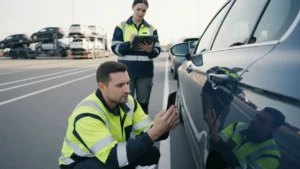
AI supports a stronger value proposition by standardizing condition evidence at each handover and connecting that evidence to exception handling and claims closure. The goal is not “more photos,” but consistent, comparable inspection outputs that can be used operationally: to trigger action, assign responsibility, and reduce the back-and-forth that stalls adjudication.
In our deployments, this distinction becomes clear when you compare what manual processes record versus what actually exists on vehicles in a live network. When we instrumented real operations, AI detected meaningful damage presence in roughly 19.6% of inspections, and the gap versus manual recording was substantial—AI surfaced about 547% more damage instances than were being captured manually. This is not a marketing detail; it explains why buyers are skeptical of quality promises without proof. If damage is under-recorded, then reported KPIs can look better than reality, attribution becomes contested, and claims become harder to settle.
What buyers respond to is a believable operating system: can you prove condition at handover, act fast on exceptions, and close claims without chaos? For that, the differentiator becomes practical and execution-oriented:
- Inspect for proof: consistent inspections that create comparable evidence packages at each handover.
- Stream for execution: exception handling that turns findings into tasks such as in-transit repairs, securement fixes, and tracked closure.
- Recover for transparency: claim-ready documentation that supports accountability and faster adjudication.
This operating system logic aligns with how value is actually created in the network; evidence without closure does not change outcomes. A useful reference point is closed-loop inspections, which captures why inspections matter most when they drive action and resolution, not when they end as static reports.
At the handover layer specifically, standardization is critical because liability often hinges on what was documented at the moment custody changed. If evidence quality varies by site, inspector, weather, or time pressure, disputes are predictable. This is why we emphasize the ability to prove condition at handover and connect it to the subsequent exception workflow. Readers who want the inspection mechanism detail can also see how AI digital vehicle inspections are typically structured in practice.
Once evidence is standardized, the next bottleneck is cycle time. Claims often slow down not because the damage is complex, but because the evidence is incomplete, inconsistent, or not easy to reconcile across parties. That pattern is captured well in the claims cycle-time trap, and it is precisely where a provable, repeatable evidence method becomes a commercial differentiator in tenders.
What to include in an outcome-based tender proposal
An outcome-based tender proposal should include a measurement plan, a reporting cadence, and an escalation workflow that shows how exceptions move from detection to closure. Buyers are not only comparing tools; they are comparing operating discipline. A proposal that describes the workflow end-to-end is easier to trust than one that lists features.
At minimum, a credible proposal should define:
- A measurement plan: which KPIs are tracked, how they are calculated, and what constitutes a compliant inspection and event record.
- A reporting cadence: who receives which dashboards or reports, how often, and how network-wide comparisons are normalized across sites and partners.
- An escalation workflow: how exceptions are triaged, who is accountable at each step, and what “closure” means operationally and contractually.
To make the workflow tangible, it helps to show how evidence becomes action rather than a passive archive. That linkage is the core idea behind from photo to action workflows, which is directly relevant to tender narratives around execution, not just detection.
For reporting artifacts, tenders benefit from specifying what a “claim-ready” evidence package includes and how it is produced consistently across the network. A practical reference is vehicle inspection reporting, which helps ground expectations for inspection outputs, certificates, and documentation quality.
Why provable outcomes protect margin in FVL
Provable outcomes protect margin by reducing administrative drag and lowering the frequency and duration of dispute loops. When damage is under-recorded or recorded inconsistently, the provider pays twice: first through operational firefighting and then through prolonged claim handling, reconciliation effort, and avoidable escalations with OEMs, carriers, and yards.
Standardized evidence and disciplined workflows change the unit economics of handling exceptions. With clearer handover proof, fewer cases bounce between parties asking for “better pictures” or “another statement,” and responsibility discussions become shorter and more evidence-led. This directly reduces the hidden workload that accumulates when evidence is weak—often described as evidence debt—and the commercial relevance is explored in the cost of evidence debt.
In practical terms, margin protection comes from:
- Less manual administration to assemble, validate, and chase evidence across stakeholders.
- Fewer disputes that require repeated reviews because the original handover record is not defensible.
- Faster claim closure, which reduces time spent per case and improves predictability of recovery.
Technology and automation context for tender-grade credibility
AI and computer vision support tender-grade credibility by making inspections consistent across inspectors, sites, and operating conditions, and by producing structured outputs that can be governed. Instead of relying on subjective descriptions and variable photo sets, computer vision models can localize and classify visible damage in a repeatable way, while the system enforces required angles, metadata capture, and completeness rules at the point of handover.
Automation matters because tenders are increasingly network-wide: evidence and performance must be comparable across dozens of compounds and multiple transport modes. Consistency at scale is what turns a KPI into something a buyer can trust, and it is also what enables exception workflows to be executed with the same standard regardless of where the vehicle is inspected.
However, credibility also depends on adoption choices. If AI is introduced as a bolt-on tool without governance, it can create parallel processes rather than better outcomes. For implementation risks and how to avoid positioning AI as a “tech add-on,” it is worth reviewing common failures when adopting AI in FVL inspections.
Conclusion
AI is becoming a differentiator in FVL tenders when it strengthens the offer with provable outcomes: defensible handover evidence, complete and timely event reporting, and faster, cleaner claims closure. The tender shift is clear—buyers are less persuaded by quality statements and more persuaded by an operating system that shows how condition is proven, how exceptions are executed, and how accountability is maintained across the network.
Our operational data illustrates why this matters: when AI reveals materially more damage than manual recording, it exposes the gap between “promised quality” and measurable reality. For OEMs, orchestrators, and logistics providers, the practical path is to treat AI as a measurement-and-execution layer—Inspect for proof, Stream for execution, Recover for transparency—so performance can be governed, disputes shrink, and margin is protected through fewer administrative loops and faster adjudication.