


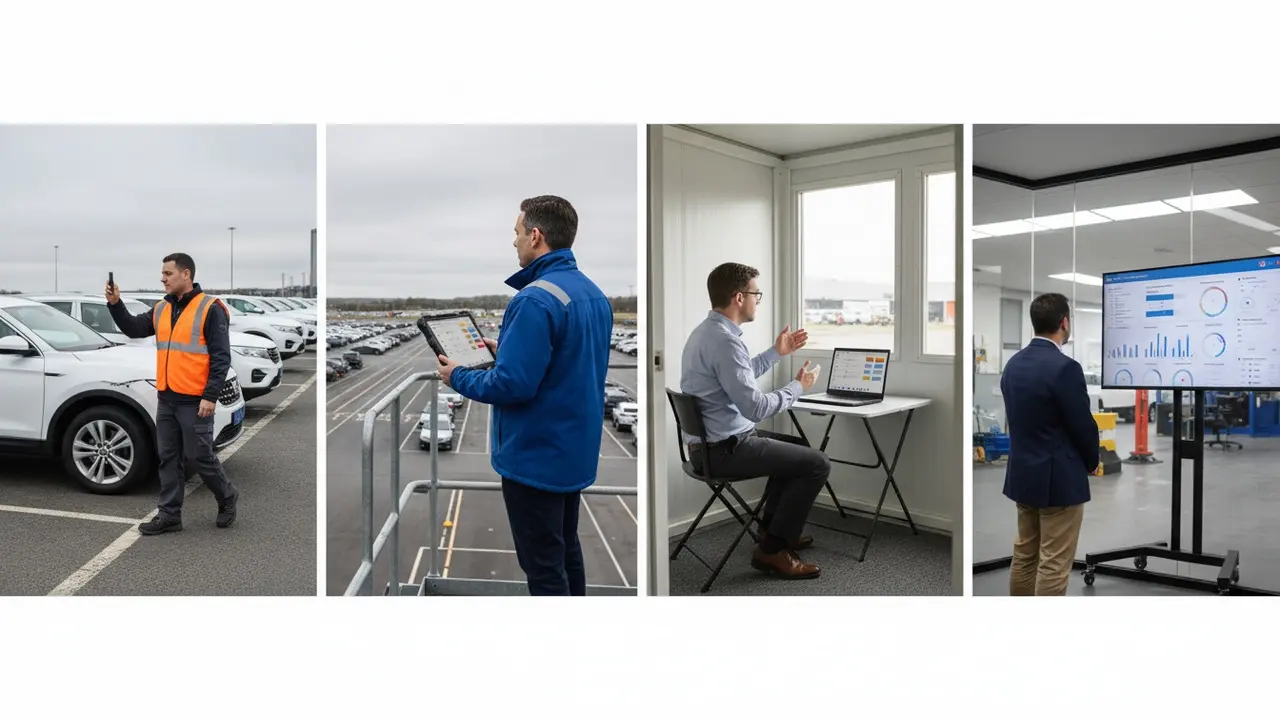

One source of truth doesn’t mean one view because the same inspection evidence must answer different operational questions for different roles. In finished vehicle logistics, image-based inspections and exception handling increasingly generate a single event record per vehicle interaction, but friction appears when everyone is forced into the same interface. This article explains why “one dashboard” fails, what role-based views look like across the logistics chain, what each role should see (and not see), and how these views reduce disputes and rework while keeping everyone aligned on the same underlying facts.
Core explanation: the same evidence must serve different decisions
A unified event record is only useful if it can be consumed as decisions. An operator’s decision is immediate and local: do we stop the unit, fix it, or release it? A site manager’s decision is systemic: where are repeated issues coming from and what should we change in process or staffing? A partner’s decision is contractual: what is the responsibility split at custody change and what is defensible in a claim? An executive’s decision is financial and directional: where is risk accumulating and what should be standardized across nodes?
When one dashboard tries to satisfy all of these decisions at once, it typically ends up overloading the frontline with analytics, under-serving managers with operational detail, and confusing partners with irrelevant internal context. The operational requirement is not “one screen for all,” but one underlying truth that can be rendered into different, role-appropriate views without duplicating evidence or rewriting narratives.
Why ‘one dashboard’ fails
A single dashboard fails because it conflates evidence capture, operational execution, analytics, and commercial accountability into one surface area. In practice, that creates three predictable failure modes.
First, it increases cognitive load at the point of action. When operators must filter through trend graphs, historical VIN timelines, or claim-status fields, the time-to-decision increases and the chance of a missed action rises, especially during peak outbound windows.
Second, it creates inconsistent interpretations. Different teams end up creating their own exports, screenshots, or “shadow” spreadsheets to extract what they need, which breaks the point of having a single truth and encourages re-interpretation instead of shared agreement.
Third, it generates reconciliation work downstream. When the same event is reframed differently for operations, partners, and claims, teams spend time reassembling context and validating whether two views describe the same incident. That reconciliation is a key driver of the hidden cost of “evidence debt” across disputes, re-inspections, and claim preparation.
The 4 role views (operator, site manager, partner, exec)
From our own platform learning, we found that “one source of truth” does not mean one UI. Different roles do not need the same dashboard—they need the same truth.
Operator view
Operators need to answer one question quickly: what do I fix right now before departure? That requires an action-first interface where evidence is translated into clear tasks and stop/go decisions rather than a general-purpose reporting view.
Site manager view
Site managers need to understand repeat patterns and root causes. They need to ask: where are repeats happening and why—by train, terminal, lane, shift, operator, or carrier? This view must support operational accountability and coaching, not just record-keeping.
Partner/OEM/4PL view
OEMs and 4PLs need VIN history across nodes with a clean separation of responsibility at each custody transition. They must be able to see what was known, when it was recorded, and under whose custody the evidence was captured, without being exposed to internal operational noise. This is where custody change is where accountability is won or lost.
Executive view
Executives need an aggregated view of risk, performance, and financial exposure. They are not looking to inspect individual images; they need to see where exception volume is concentrated, which partners or lanes drive the highest dispute rate, and what cycle-time or recovery performance looks like across the network.
What each view needs (and what it should hide)
Role-based views work when each view is optimized for the decisions that role can actually take, and when irrelevant fields are intentionally hidden to prevent misinterpretation and distraction.
Operator view needs:
- A prioritized task list tied to the current outbound plan (for example: “repair before load,” “clean before photo set,” “hold for supervisor”).
- Clear thresholds for action (damage severity, location, and whether it blocks release).
- Fast access to the minimum evidence needed to act: annotated images, damage classification, and required confirmation steps.
Operator view should hide: multi-node VIN history, partner liability discussion fields, and network-wide KPIs. Those elements encourage debate at the line level instead of execution. Where needed, the operator view should connect evidence directly into workflows that turn evidence into tasks and workflows.
Site manager view needs:
- Trend and repeat analysis with breakdowns by terminal, lane, carrier, shift, and operator.
- Drill-down from KPI to underlying event records so supervisors can validate patterns without re-inspecting units.
- Exception categories aligned to how work is managed (for example, load damage vs. yard incidents vs. inbound condition).
Site manager view should hide: detailed commercial negotiation threads and claim-status workflow steps that do not support root-cause action on site. Instead, it should focus managers on operational signals and fleet and operations metrics that actually move performance.
Partner/OEM/4PL view needs:
- A VIN-level timeline across nodes showing event records in sequence.
- Explicit custody markers and handover checkpoints so responsibility boundaries are unambiguous.
- Standardized evidence packets: consistent photo sets, timestamps, location/site identifiers, and damage taxonomy.
Partner/OEM/4PL view should hide: internal staffing notes, internal performance coaching details, and non-essential operational tags. Partners require clarity, not internal commentary, and overexposure often triggers unnecessary dispute.
Executive and claims-leadership view needs:
- Exception volume, dispute rate, and recovery performance summarized by network segment (terminal, lane, partner, OEM program).
- Audit-ready evidence readiness indicators: which events have complete documentation and which require follow-up before a claim can be submitted.
- Integration-ready outputs so evidence can move into downstream systems without reformatting.
Executive and claims-leadership view should hide: operational micro-steps and line-level task queues. For claims in particular, what matters is standardized, defensible evidence—many teams stay manual precisely because this standardization is missing, which is why claims processes stay manual without standardized evidence.
How role-based views reduce disputes and rework
Role-based views reduce disputes and rework by keeping interpretation consistent while tailoring consumption. The platform mechanism is straightforward: one event record, multiple role renderings, and controlled context.
In our own discovery, the value was not only user experience—it was operational alignment. Operators could execute faster because they saw tasks instead of analytics. Managers could isolate repeat issues by node or lane without asking teams to rebuild reports. Partners could review VIN history across nodes with custody boundaries clearly defined, reducing “he said, she said” conversations at handover. Claims teams could use standardized, audit-ready evidence that synchronizes into downstream systems, reducing the back-and-forth that typically happens when photo sets, timestamps, or damage descriptions vary.
Standardization is the core dispute reducer: when the same incident is documented consistently at each node, conversations shift from arguing about what happened to deciding how to resolve it. That is also why disputes explode when standards aren’t consistent. With role-based views, you do not force every stakeholder into the same UI to achieve consistency; you enforce consistency in the underlying record and governance of what each role can change or comment on.
The downstream effect is shorter resolution loops. When evidence packets are complete and structured at the moment of capture, claims cycle time stops being a recurring operational drag, because less time is spent reconstructing context across emails and portals. For many networks, claims cycle time becomes a hidden operational trap when evidence is fragmented or reformatted across roles.
Technology and automation context: one record, multiple renderings
AI-enabled inspection platforms make role-based views feasible because they can standardize evidence at scale while keeping traceability intact. Computer vision models can detect and classify visible damage consistently across sites, which reduces variation introduced by different inspectors or local habits. Once the system generates structured attributes—damage type, location, severity, timestamps, and annotated imagery—the same underlying event record can be rendered differently without rewriting it.
Operationally, this separation matters. It allows automation to support:
- Consistency: the same taxonomy and evidence structure across terminals and partners.
- Scalability: high-volume inspection throughput without degrading documentation quality.
- Control: role-based permissions over what can be edited, approved, or escalated.
- Auditability: a defensible chain of evidence aligned to custody moments and downstream claim requirements.
This is how “one source of truth” becomes practical: not as one screen, but as one governed record with multiple task-, trend-, and liability-oriented lenses.
Conclusion
One source of truth does not require one dashboard. In vehicle logistics, the same inspection evidence must drive different decisions: operators need immediate tasks, managers need repeat and root-cause trends, partners need liability clarity across custody changes, and executives need aggregated risk and recovery signals.
Role-based views reduce disputes and rework by keeping everyone anchored to the same underlying event record while removing irrelevant context that causes delay or misinterpretation. When evidence is standardized, audit-ready, and reusable across roles, the network spends less time reconciling versions of the story and more time executing, correcting root causes, and resolving claims with fewer arguments.