


The Claims Cycle-Time Trap
The claims cycle-time trap: why do damage claims stall for weeks?
Damage claims stall for weeks because the underlying evidence and damage coding are not consistent or comparable across custody handovers. What looks like “slow processing” is usually a reconciliation problem: stakeholders are trying to prove that the same damage event is being discussed, using different photos, different notes, and different codes. This article explains where claims typically get stuck, what “good evidence” means in finished vehicle logistics, why cycle time quickly becomes a financial and relationship risk, and a practical closure checklist teams can use to move claims faster.
Core explanation: cycle time inflates when evidence cannot be compared across handovers
In finished vehicle logistics, a claim is rarely blocked by a single missing item. It slows down when the chain cannot establish continuity: whether a defect observed at one handover is the same defect being disputed later, and whether it occurred under the responsibility of a specific custodian. If one party documents with photos, another uses free-text notes, and another uses a code set that does not map cleanly, the claim turns into manual interpretation work. That work multiplies across emails, follow-up calls, and re-inspections, and each loop adds delay and ambiguity.
In our own analysis, we initially assumed “claims are slow because claims teams are slow.” When we followed claims through the chain, the opposite pattern appeared: people were working, but the claim stalled because the evidence did not match. One stakeholder had images, another had notes, a third used a different code, and a fourth disputed whether it was the same damage. A “simple” case became a multi-week thread because the file lacked a comparable, structured record that survived the handover.
Where claims get stuck: handover proof, coding, and operational context
Claims most often stop moving at the interfaces between organizations and systems. Each interface introduces a documentation style, a vocabulary, and a threshold for what is considered “provable.” When those are not aligned, the claim is not denied outright; it is put into a holding pattern while parties ask for “better photos,” “the right code,” or “proof it was there at pickup.”
Handover proof. The handover is the legal and operational boundary where custody changes, so it is also where proof must be strongest. If inspections are not tied clearly to time, location, VIN, and the responsible party at that moment, later evidence becomes contestable. A photo without traceability becomes an opinion rather than proof, especially when multiple moves occur before the claim is filed. Readers who want to go deeper on this accountability breakpoint can review the handover moment.
Coding. Damage codes are meant to standardize interpretation, but in practice coding varies by site, vendor, or claims platform. Even when two parties are “right,” their codes may not be comparable, which forces manual translation and opens room for disagreement about severity, panel location, or repair method. This is the operational reality behind when standards are optional, disputes are guaranteed.
Context. Evidence without context creates extra loops. A close-up photo might show damage, but not whether it is new, where on the vehicle it is, whether the surrounding panel is affected, or whether it is consistent with transport handling. Without consistent context fields, stakeholders cannot align on “same damage” versus “different damage,” and the claim becomes a debate rather than a workflow. This is how operational friction accumulates into the cost of “evidence debt” over time.
What good evidence looks like in a finished vehicle logistics claim
Good evidence is evidence that different parties can interpret the same way, without needing additional explanation. It does not just prove that damage exists; it proves comparability across handovers and supports an audit trail that can survive disputes, system migrations, and time delays.
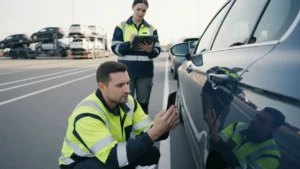
It starts at the source: a consistent vehicle damage inspection process that produces structured outputs rather than ad-hoc artifacts. Practically, “good evidence” in claims has three properties.
Comparable capture. Images should be repeatable across events, meaning similar angles, sufficient lighting, and a clear view that anchors the damage to a specific area of the vehicle. The goal is not more photos; the goal is photos that can be compared across two inspections to confirm continuity or change.
Consistent structure. Damage descriptions need standardized fields so stakeholders are not forced to interpret free text. At minimum, the record should align on panel/zone, damage type, severity, and a code set that the upstream and downstream parties can map. This is where workflow discipline matters as much as the inspection itself, which is why we emphasize from photo to action workflows rather than treating claims as a pure documentation problem.
Traceability to custody change. A claim accelerates when the evidence is clearly tied to a custody event with timestamps, location/site identifiers, user or device provenance, and version history. That makes it materially harder to dispute “when it happened” and reduces the back-and-forth that typically expands cycle time.
Why cycle time costs money and relationships in vehicle logistics networks
Cycle time costs money because delay increases leakage and reduces the probability of closure. In our dataset, roughly 56% of damage claims never reach resolution; the remaining cost is absorbed by the OEM rather than allocated to the responsible party. That means cycle time is not a neutral administrative metric; it is a leading indicator of whether cost recovery will happen at all. If your network wants to reduce the frequency of paying for events you did not cause, stop paying for damage you didn’t cause provides a broader view of the mechanisms behind that loss.
Cycle time also costs relationships because unresolved or slow claims change how partners behave. When liability is unclear, stakeholders become defensive: more exceptions are escalated, more handovers are treated as high-risk, and collaboration becomes procedural rather than operational. The commercial impact is not only the repair value; it is the time spent by operations, claims, and quality teams re-litigating the same event. Over time, this drives a perception of unfairness in cost allocation, which is why discussions about who pays for damages become contentious when evidence is inconsistent.
Closure checklist: what a claim needs to move without rework
A claim moves quickly when it is prepared as a package that another organization can accept without translation. The following checklist focuses on the minimum closure requirements that reduce dispute loops and prevent the claim from turning into a correspondence thread.
- VIN matched consistently across inspection, claim, and repair documentation.
- Timestamp and location for the inspection tied to the custody handover event.
- Named responsible party for each custody interval, aligned with the handover record.
- Damage mapped to a standardized panel/zone and a consistent code set or code mapping table.
- Comparable photos including at least one contextual shot (vehicle orientation/panel) and one detail shot (damage clarity).
- Severity and repairability fielded in a consistent way so downstream teams do not reclassify from scratch.
- Versioned audit trail showing what changed, who changed it, and when.
- Export or system sync that preserves the structure (not just attachments), so the receiving party does not retype and recode.
Teams standardizing capture at the source can also align this checklist with a broader vehicle inspection checklist to reduce variation between sites and vendors.
Technology and automation context: how structured AI inspection reduces cycle-time variance
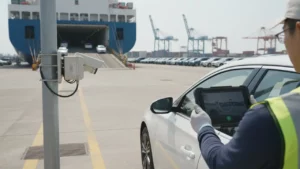
AI and computer vision reduce cycle-time variance by enforcing consistency at the moment evidence is created and by keeping that structure intact through downstream handovers. In our approach, we built backwards from the outcome we wanted: a claim that can move through multiple stakeholders without re-interpretation. That is why our inspection layer focuses on producing comparable evidence, consistent codes, and a clean audit trail tied to custody change.
We also learned that evidence without structure still creates work. When humans must retype descriptions, recode damage, and manually attach photos into claims portals or TMS/claims systems, errors and delays are introduced at exactly the point where the claim should accelerate. Our recovery workflow exists to synchronize inspection and damage outputs into the formats and systems claims teams rely on, reducing the “translation step” that keeps claims manual. For readers who want the broader context of why this translation persists, see why claims stay manual.
Finally, cycle time is not only a claims function; it is an upstream quality and operations signal. When exceptions are identified and resolved earlier—before the asset moves again—there are fewer ambiguous handover disputes to begin with. That reduces claim volume and increases closure rates because fewer cases require multi-party reconstruction of events.
Conclusion: escaping the cycle-time trap requires comparable evidence, consistent coding, and traceable handovers
The claims cycle-time trap is created when handover proof, coding, and context are inconsistent across parties. Claims do not drag because people are idle; they drag because stakeholders cannot compare evidence, cannot map codes, and cannot tie records cleanly to custody changes. Our observations show that long-running claims correlate with non-closure, and in practice a large share of losses end up absorbed by OEMs when resolution never happens.
Vehicle logistics networks that want faster, more defensible claims should focus on three operational levers: standardize evidence capture so it is comparable, enforce consistent structure so it is machine- and human-readable across systems, and maintain an audit trail anchored to the handover moment. When those are in place, cycle time stops being a chronic dispute driver and becomes a manageable workflow metric.