
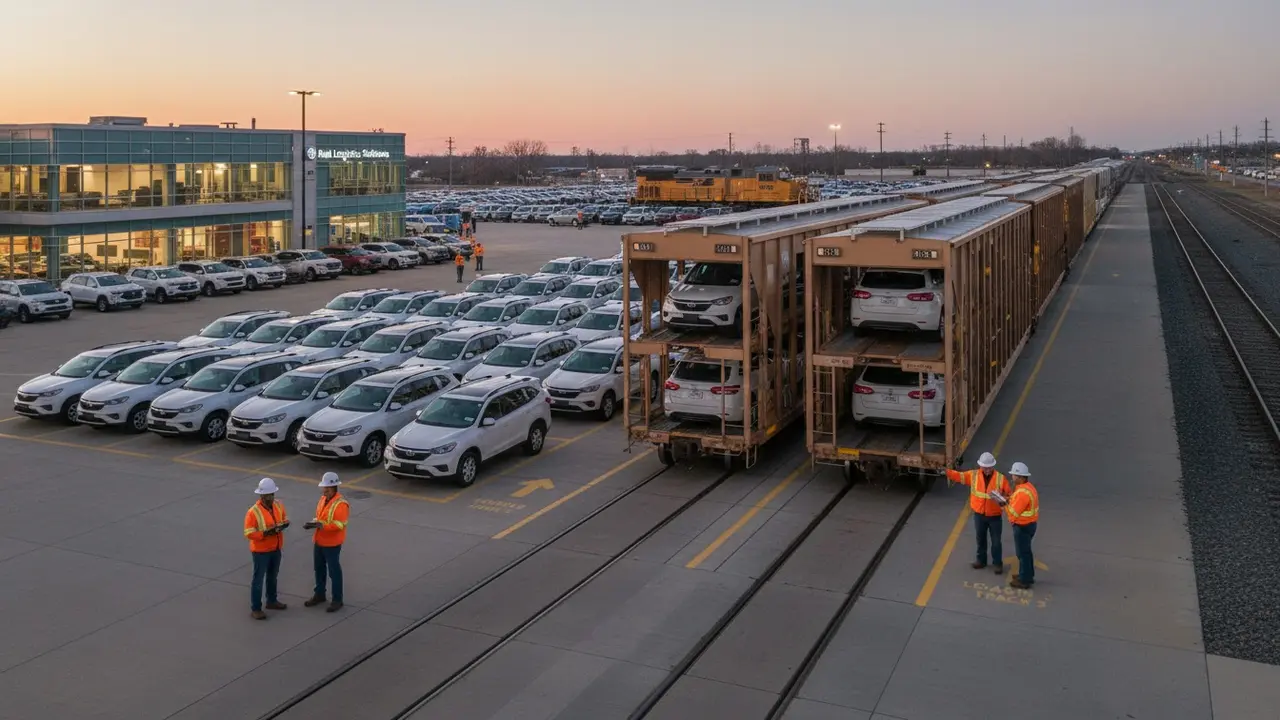

Rail claims “explode” because verification collapses at interchange points where multiple parties, workflows, and inspection standards meet. In finished vehicle logistics, rail adds unique complexity: vehicles move in dense, high-throughput batches, responsibility changes hands fast, and evidence is often captured inconsistently. This article explains why rail claims become heavy, where proof typically breaks, and how condition capture at the right touchpoints reduces friction without waiting for the whole network to align.
Core explanation: why verification is hard in rail claims
Rail is unforgiving because the claim is rarely about a single photo or a single moment. A vehicle can be touched by an OEM compound, a ramp operator, a railroad, and a destination terminal before it reaches a dealer. Each party may document condition differently, at different times, with different definitions of what constitutes reportable damage versus transport-related marks. When a dispute happens, the operational question becomes simple but difficult to answer: what was the vehicle’s condition and securement state at the last responsible handover?
In practice, rail verification fails when evidence is not comparable across touchpoints. If one inspection is a quick walkaround, another is a set of low-angle photos, and a third is a checklist with no images, the “audit trail” exists only on paper and in email threads. That mismatch creates manual reconciliation work, delays, and disagreement—especially when volume peaks compress inspection time and quality degrades under pressure.
Why rail is unique (interchange complexity)
Rail claims are uniquely multi-party because interchange is built into the operating model: loading, departure, arrival, unloading, and subsequent transfers are separate accountability moments. The outcome is that “proof” becomes fragile—not because people do not care, but because context changes quickly and evidence standards are rarely identical between organizations.
This is why we often see rail disputes follow the same pattern: the claim is raised with partial evidence, each party searches for their own records, and the handover that should anchor liability becomes ambiguous. The sector already recognizes that the decisive moments are the handover moments where accountability is won or lost; rail simply concentrates more of those moments into a shorter, higher-volume window.
Our own observation in rail operations reinforced another rail-specific reality: rail inspection is not only “damage.” It is also vehicle spacing, securement, and identification details such as seal numbers. When those elements are treated as separate or optional, claims analysis loses the operational context that explains why damage occurred and when it became likely.
Where verification breaks
Verification breaks most often in three places: inconsistency, incompleteness, and non-actionable capture. Inconsistency shows up when parties use different inspection steps and thresholds, so like-for-like comparison is impossible. This is the scenario described in when standards are optional, disputes are guaranteed: if the inspection “standard” changes by terminal or operator, disputes are structurally more likely.
Incompleteness is common at rail peaks. Trains load and unload under time constraints, and evidence collection competes with throughput. The result is missing angles, missing VIN linkage, and missing context such as railcar ID or load line placement. This becomes the cost of evidence debt in operational form: claims teams spend time reconstructing events rather than validating them, and liability discussions drift toward opinion rather than proof.
Non-actionable capture is the quiet failure mode. A checklist that says “securement OK” does not explain what was checked, what was borderline, or what changed later. In rail, this matters because securement is not a compliance afterthought; it is causal. We repeatedly saw that if securement is missed or superficially checked, damage is often created later in transit. That causal chain is covered directly in damage starts with securement, and it is the reason rail evidence must include securement state, not only post-event damage photos.
What reduces friction (condition capture at key touchpoints)
Friction drops when condition is captured in a repeatable way at the touchpoints that decide liability: load, pre-departure, arrival, and unload. In our rail work, we embedded rail workflows and securement checks and built exception alerts before departure, because the most valuable claim is the one that never becomes a claim. This aligns with the operational principle in stop damage before departure: fix upstream issues while the train is still on site, instead of documenting downstream outcomes after responsibility has already shifted.
Practically, that means moving from informal “pass/fail” inspection habits to structured condition capture tied to the transport unit. Our rail module focuses on inspections directly on railcars so that each photo and observation is connected to the identifiers that matter for disputes. The workflow is designed to match how ramps actually operate, including bi-level and tri-level railcars, and to capture both damage and the preconditions that often create damage.
In our rail deployments, operators capture photos on the railcars to detect and record:
- Vehicle damage.
- Vehicle spacing and placement on the load line.
- Securement exceptions, including straps and chocks.
- Seal numbers and other identification details.
Each capture is tied to VIN, railcar, and train, which creates an audit trail that holds up across parties because it is anchored to shared identifiers rather than informal descriptions.
We also learned that rail requires securement to be measured as exceptions, not as generic compliance. Our dedicated models detect the problems that actually drive downstream damage and disputes:
- Strap exceptions such as missing, loose, or misrouted straps.
- Chock exceptions such as broken, mis-placed, missing, or wrong placement.
- Vehicle spacing exceptions that indicate incorrect positioning or load line risk.
This turns rail inspection from “documentation” into operational control. It also supports treating securement exceptions as a KPI, which is how teams start trending risk by terminal, lane, operator, and railcar type rather than re-litigating one-off disputes.
Finally, friction reduces when evidence is visible to each stakeholder in the form they can act on. Railroads, ramp operators, and OEMs do not need the same dashboard view, but they do need a consistent underlying record. That multi-stakeholder requirement is the logic behind one source of truth doesn’t mean one view: shared evidence, role-specific visibility, and consistent identifiers reduce argument over “whose system is correct.”
Start where volume is highest
Rail claims feel network-wide, but rollouts do not need to be. The fastest way to create defensible verification is to start where volume peaks concentrate risk: the terminals, lanes, and train builds that generate the most movements and the most handovers. Those locations are where inspection quality is most likely to collapse under time pressure, and where a consistent workflow has the highest immediate impact on evidence completeness and securement control.
From an execution standpoint, this is also the most realistic adoption path in rail’s multi-party ecosystem. You can start visibility without the whole chain by standardizing capture at one or two high-volume touchpoints first, then expanding once the data proves where exceptions originate and where accountability is unclear.
Technology and automation context: how computer vision makes rail evidence comparable
Computer vision supports rail verification by turning unstructured photos into structured, comparable records across operators and terminals. The operational gain is consistency: the same set of required captures, the same object-level checks (strap, chock, spacing), and the same linkage to VIN, railcar, and train. That is what allows evidence to survive interchange and reduces the “manual glue work” that keeps rail claims operations slow even when everyone wants automation. The broader dynamic is explored in why claims stay manual: fragmented inputs and non-standard evidence force people back into email, spreadsheets, and subjective interpretation.
In rail specifically, automation also changes timing. When securement exceptions are detected and alerted before departure, the system supports corrective action in the same operational window where the root cause can still be fixed. That is materially different from traditional claims evidence, which is often assembled after the fact to assign liability rather than to prevent the outcome.
Conclusion
Rail claims become heavy because verification is hardest exactly where accountability changes hands: multiple parties, uneven standards, peak throughput, and incomplete context. Our rail experience shows that inspection must include not only visible damage but also spacing, securement, and identifiers such as seal numbers, because securement gaps often create the damage later. The practical path to lower friction is structured condition capture at key touchpoints, rail-specific workflows that enforce comparable evidence, and exception alerts before departure. For OEMs, railroads, and ramp operators, this is the difference between disputing a story and validating a record—so teams can stop paying for damage you didn’t cause and resolve claims with defensible proof rather than manual reconstruction.
